


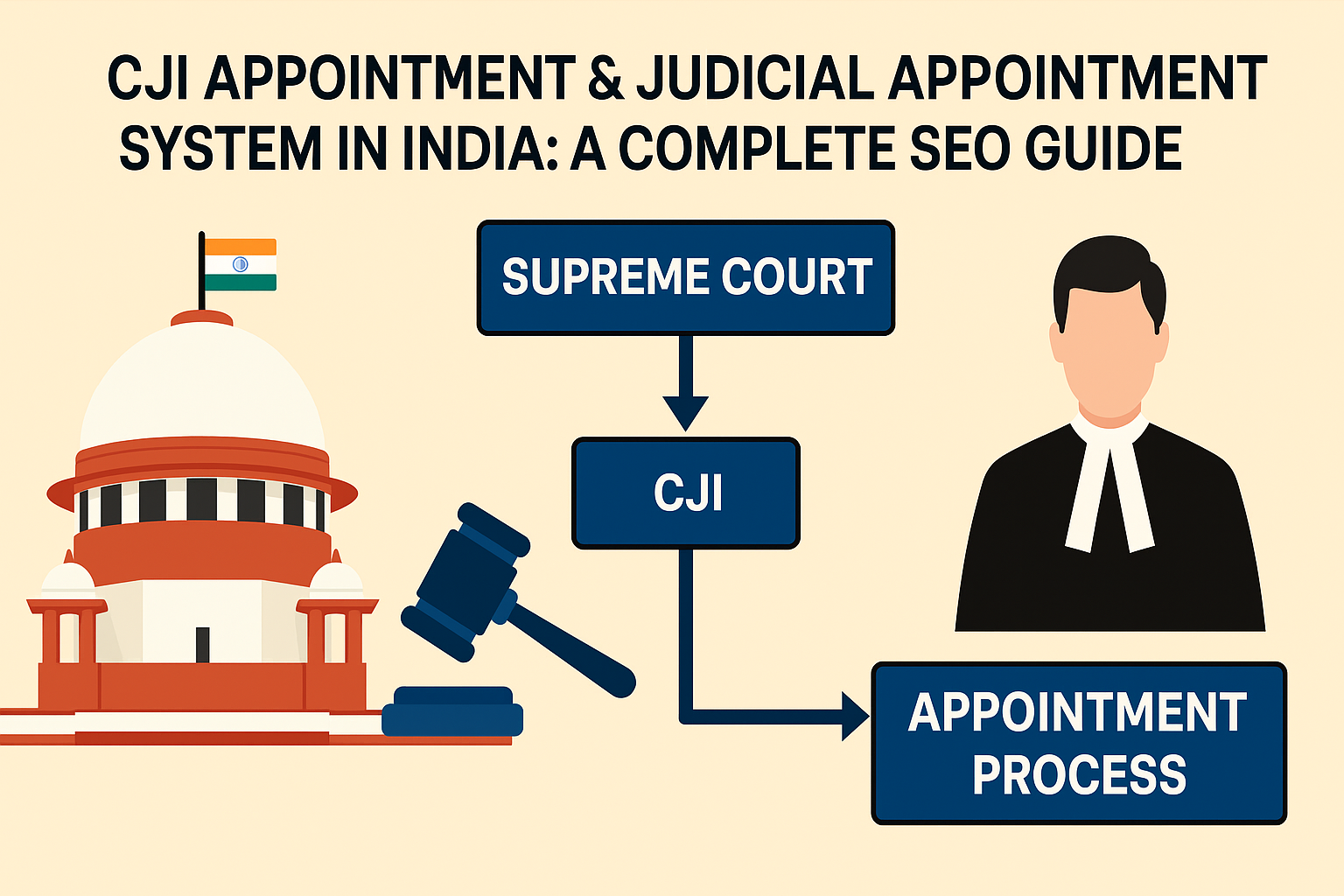
The appointment of the Chief Justice of India (CJI) and other judges of the higher judiciary is central to the independence of the judiciary in India. The system is rooted in the Constitution of India—primarily Article 124(2) and Article 217—and has been refined through a series of landmark Supreme Court judgments, collectively known as the Three Judges Cases, which gave rise to the Collegium System.
This article explains the process of appointing the CJI, the functioning of the Collegium System, the NJAC controversy, and the major criticisms and justifications surrounding judicial appointments in India.
Constitutional Basis of Judicial Appointments
Article 124(2) – Supreme Court Judges and CJI
Article 124(2) provides that every judge of the Supreme Court is appointed by the President after consultation with such judges of the Supreme Court and of the High Courts as the President may deem necessary. The CJI is also appointed under this provision.
Article 217 – High Court Judges
Article 217 deals with the appointment of judges of High Courts. High Court judges are appointed by the President after consultation with:
- The Chief Justice of India,
- The Governor of the concerned state, and
- The Chief Justice of the concerned High Court.
These provisions created a consultative model, which the Supreme Court later interpreted to give primacy to the judiciary itself.
Appointment of the Chief Justice of India (CJI)
The CJI is the head of the Indian judiciary and the Master of the Roster of the Supreme Court. While the Constitution does not specify a separate procedure for appointing the CJI, the process has evolved through convention and the Memorandum of Procedure (MoP).
Key Features of CJI Appointment
1. Constitutional Basis
Under Article 124(2), the President appoints the CJI as a judge of the Supreme Court. Unlike ordinary judges, there is no explicit requirement of “consultation” for appointing the CJI, but practice and convention have filled this gap.
2. Convention of Seniority
By long-standing convention, the senior-most judge of the Supreme Court who is considered fit is appointed as the CJI.
This convention:
- Checks executive discretion,
- Prevents arbitrary supersession, and
- Strengthens judicial independence.
Departures from this convention in the 1970s (when senior judges were superseded) were widely criticised and are now treated as aberrations.
Appointment Procedure (Memorandum of Procedure)
The MoP lays down the detailed steps followed in practice:
- Initiation by Law Ministry
The Union Minister of Law and Justice writes to the outgoing CJI, seeking a recommendation for the next CJI, usually about one month before retirement. - Recommendation by Outgoing CJI
The outgoing CJI recommends the name of the senior-most Supreme Court judge suitable for appointment as the next CJI. - Processing by the Government
The Law Minister forwards this recommendation to the Prime Minister. - Advice to the President
The Prime Minister advises the President of India to appoint the recommended judge as CJI. - Formal Appointment
The President signs the warrant of appointment, and the new CJI takes the oath of office.
Term and Removal of the CJI
- Tenure: Like all Supreme Court judges, the CJI holds office until the age of 65 years.
- Removal: The CJI can be removed only through a process of impeachment under Article 124(4), which requires:
- An address by each House of Parliament,
- Supported by a special majority, and
- On grounds of proved misbehaviour or incapacity.
This stringent procedure further insulates the office from political pressure.
The Collegium System: Judges Appointing Judges
The Collegium System is the mechanism by which appointments and transfers of judges to the Supreme Court and High Courts are made. It does not appear in the text of the Constitution; instead, it emerged through judicial interpretation of the word “consultation” in Articles 124 and 217.
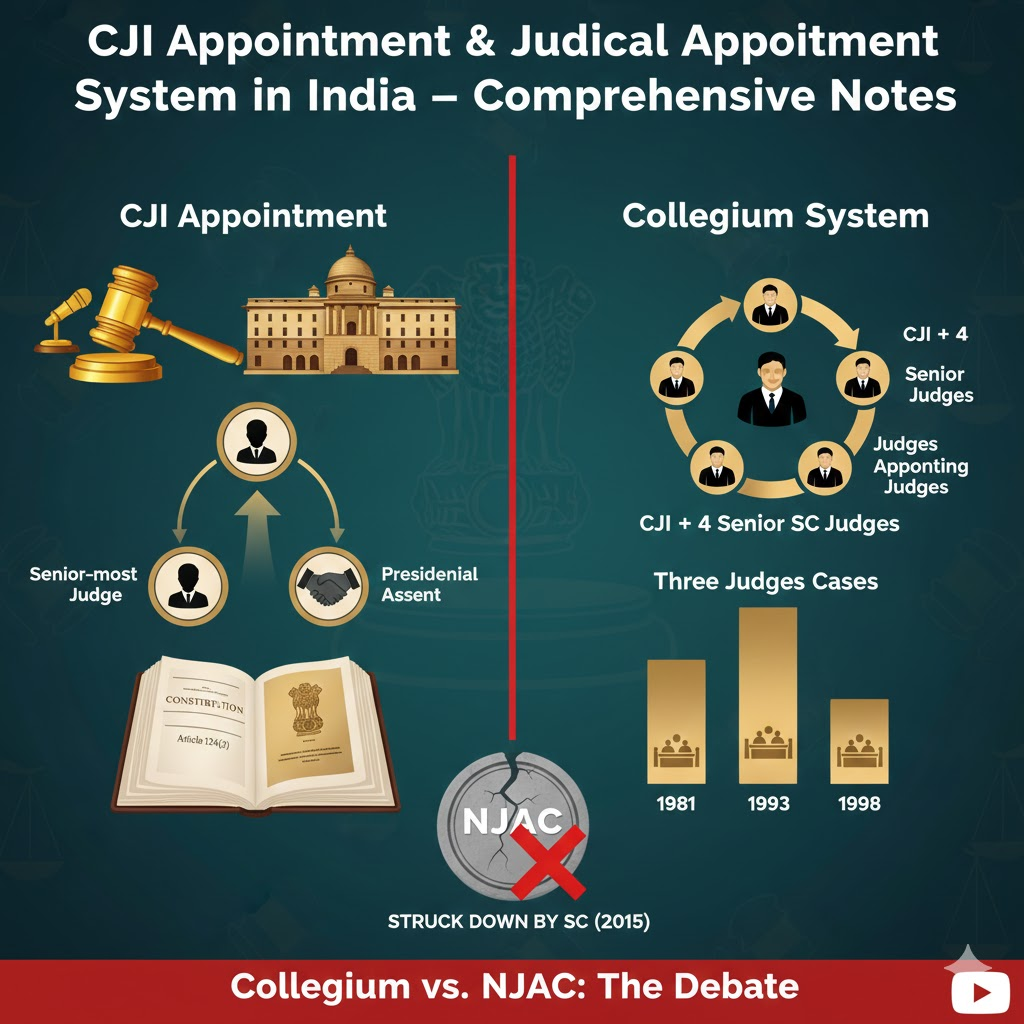
Evolution Through the Three Judges Cases
| Case | Year | Key Principle | Impact |
|---|---|---|---|
| First Judges Case – S.P. Gupta v. Union of India | 1981 | Held that “consultation” does not mean “concurrence”. | Gave primacy to the Executive in judicial appointments. |
| Second Judges Case – Supreme Court Advocates-on-Record Association v. Union of India | 1993 | Overruled the First Judges Case; held that “consultation” effectively means “concurrence” of the CJI. | Gave primacy to the Judiciary; created a Collegium led by the CJI + 2 senior judges. |
| Third Judges Case – In re Presidential Reference | 1998 | Clarified and expanded the Collegium System. | Established the present-day Collegium of CJI + 4 senior-most judges for Supreme Court appointments. |
Current Collegium Composition
| Court | Collegium Composition |
|---|---|
| Supreme Court | CJI + four senior-most Supreme Court judges |
| High Court | Chief Justice of the High Court + two senior-most High Court judges |
The Supreme Court Collegium also plays a key role in appointing and transferring High Court judges.
Role of the Government in the Collegium System
The Collegium System does not completely exclude the Executive. The government has a limited but important role:
- It may seek clarifications or request reconsideration of a recommendation.
- It obtains Intelligence Bureau (IB) inputs and other background checks on proposed appointees.
- However, if the Collegium unanimously reiterates its recommendation, the government is constitutionally bound to make the appointment.
Thus, while the judiciary has primacy, the executive still participates in the process.
The NJAC Controversy: Collegium vs. Reform
The Collegium System has long faced criticism for opacity, lack of accountability, and potential nepotism. In response, Parliament attempted to replace it with a more broad-based commission.
National Judicial Appointments Commission (NJAC)
- Created by:
- The 99th Constitutional Amendment Act, 2014, and
- The NJAC Act, 2014.
- Objective: To create a transparent, participatory body for appointing judges, involving both the judiciary and the executive.
Proposed Composition of NJAC
- Chief Justice of India (Chairperson, ex officio)
- Two senior-most Supreme Court Judges (ex officio)
- Union Minister of Law and Justice (ex officio)
- Two Eminent Persons, selected by a committee consisting of:
- Prime Minister
- CJI
- Leader of Opposition in the Lok Sabha (or leader of the largest opposition party)
This design aimed to dilute judicial monopoly and introduce broader accountability.
Striking Down of NJAC
In Supreme Court Advocates-on-Record Association v. Union of India (2015), often called the Fourth Judges Case, the Supreme Court:
- Struck down the 99th Constitutional Amendment and the NJAC Act, and
- Declared them unconstitutional.
Reasoning of the Court
- The Court held that NJAC violated the Basic Structure Doctrine, particularly the principle of Judicial Independence.
- Giving the executive and “eminent persons” a decisive role was seen as potentially compromising the separation of powers.
Outcome:
The Collegium System was revived and reaffirmed as the governing mechanism for judicial appointments.
Criticisms of the Collegium System
The debate did not end with the restoration of the Collegium. It continues to attract sharp criticism as well as strong defence.
Major Arguments Against the Collegium
- Lack of Transparency
- No publicly available criteria for selection.
- Collegium resolutions were historically not disclosed, though some information is now released.
- Possibility of Nepotism and Favouritism
- Allegations of “uncle judges” and preferential treatment of relatives or favourites.
- Questionable Constitutional Basis
- System not expressly created by the Constitution, but by judicial pronouncements, raising concerns about judicial overreach.
- Delays in Appointments
- Prolonged vacancies in High Courts and the Supreme Court.
- Friction between government and Collegium often slows the process.
Arguments in Favour of the Collegium
- Protection of Judicial Independence
- Limits executive influence over appointments, which is vital in a system where judges must often review state actions.
- Expert Evaluation
- Judges are considered best placed to evaluate the legal acumen, integrity, and temperament of potential appointees.
- Checks and Balances
- The government still has a role—through intelligence inputs and the power to seek reconsideration—providing some external check.
- Basic Structure Doctrine
- An independent judiciary is part of the Basic Structure, so any system undermining it must be carefully scrutinised.
Continuing Debate: Collegium vs. Alternative Models
The debate in Indian constitutional law now largely revolves around how to reform the appointment process without eroding judicial independence.
Key issues in the debate include:
- Should there be a reformed appointments commission with limited executive role?
- Can we have codified criteria for appointments, such as merit, diversity, representation, and integrity?
- How much of the Collegium’s reasoning should be made public, and how much must remain confidential?
While there is broad agreement that the Collegium needs greater transparency and structure, there is equal concern that any major role for the executive could undermine the core value of an independent judiciary.
Conclusion
The appointment of the Chief Justice of India and judges of the higher judiciary is not a mere administrative task—it lies at the heart of India’s constitutional democracy. Through Articles 124 and 217, and especially via the Three Judges Cases, India has created a unique system where judges largely appoint judges through the Collegium, with the executive playing a supporting but limited role.
The attempt to replace this system with the NJAC highlighted genuine concerns of opacity and accountability, but the Supreme Court’s decision to strike it down re-emphasised that judicial independence is non-negotiable as part of the Basic Structure.
The challenge going forward is to reform, refine, and improve the existing system—making it more transparent, inclusive, and efficient—while preserving the essential principle that a free judiciary must never be at the mercy of transient political majorities.
Prelims Practice Questions
Q1. With reference to the appointment of the Chief Justice of India, consider the following statements:
- The Chief Justice of India is appointed by the President of India under Article 124(2).
- The Constitution explicitly provides that the senior-most judge shall be appointed as the CJI.
- The convention of seniority was evolved to ensure judicial independence.
Which of the statements given above are correct?
A. 1 and 2 only
B. 1 and 3 only
C. 2 and 3 only
D. 1, 2 and 3
✅ Correct Answer: B
Explanation:
Statement 2 is incorrect because the Constitution does not explicitly mention the seniority principle; it is a convention.
Q2. Consider the following pairs:
| Case | Principle Established |
|---|---|
| 1. S.P. Gupta Case | Judicial primacy in appointments |
| 2. Second Judges Case | Establishment of Collegium System |
| 3. Third Judges Case | Expansion of Collegium to 5 members |
Which of the above pairs are correctly matched?
A. 1 and 2 only
B. 2 and 3 only
C. 1 and 3 only
D. 1, 2 and 3
✅ Correct Answer: B
Explanation:
S.P. Gupta Case gave primacy to the Executive, not judiciary.
Q3. Which of the following correctly describes the present Collegium System for Supreme Court appointments?
A. CJI + two senior-most Supreme Court judges
B. CJI + three senior-most Supreme Court judges
C. CJI + four senior-most Supreme Court judges
D. CJI + Union Law Minister + Judges
✅ Correct Answer: C
Q4. Consider the following statements regarding the National Judicial Appointments Commission (NJAC):
- It was established by the 99th Constitutional Amendment Act.
- It included the Prime Minister as an ex-officio member.
- It was struck down by the Supreme Court for violating the basic structure.
Which of the statements given above are correct?
A. 1 and 2 only
B. 1 and 3 only
C. 2 and 3 only
D. 1, 2 and 3
✅ Correct Answer: B
Q5. With reference to High Court Judges, consider the following:
- They are appointed under Article 217 of the Constitution.
- The Governor of the State is consulted in the process.
- The Union Public Service Commission plays a role in their selection.
Select the correct answer:
A. 1 and 2 only
B. 2 and 3 only
C. 1 and 3 only
D. 1, 2 and 3
✅ Correct Answer: A
Q6. Which of the following statements best explains the term “Collegium System”?
A. A constitutional body created by Parliament
B. A system of election of judges by Parliament
C. A judicially evolved system for appointments of judges
D. An executive committee for judicial oversight
✅ Correct Answer: C
Q7. Which of the following provisions ensure the independence of the Chief Justice of India?
- Security of tenure
- Difficult impeachment procedure
- Fixed salary and allowances charged on Consolidated Fund of India
- Discretion of the Prime Minister in removal
Select the correct answer:
A. 1, 2 and 3 only
B. 1 and 4 only
C. 2 and 4 only
D. 1, 2, 3 and 4
✅ Correct Answer: A
Q8. Assertion (A):
The Collegium System ensures judicial independence.
Reason (R):
It prevents the executive from exercising unchecked control over judicial appointments.
Choose the correct answer:
A. Both A and R are true and R is the correct explanation of A
B. Both A and R are true but R is not the correct explanation
C. A is true but R is false
D. A is false but R is true
✅ Correct Answer: A
Q9. Which one of the following statements is correct?
A. The President has absolute discretion in appointing the CJI.
B. The NJAC currently governs judicial appointments.
C. The Collegium System evolved through Supreme Court judgments.
D. UPSC appoints Supreme Court judges.
✅ Correct Answer: C
Q10. Consider the following statements:
- If the Collegium reiterates its recommendation, the government is bound to accept it.
- The term of the CJI is fixed at 6 years.
- The removal of CJI requires special majority of Parliament.
Which of the statements above are correct?
A. 1 and 2 only
B. 2 and 3 only
C. 1 and 3 only
D. 1, 2 and 3
✅ Correct Answer: C
Consider the following statements:
- The Collegium System is mentioned in the Constitution of India.
- It was upheld after striking down the NJAC.
Which of the statements given above is/are correct?
A. 1 only
B. 2 only
C. Both 1 and 2
D. Neither 1 nor 2
✅ Correct Answer: B