
Preparing for UPSC Civil Services Exam 2026 requires consistent answer-writing practice and conceptual clarity. This week’s UPSC Mains GS Paper 1 Answer Writing Practice focuses on two high-probability areas:
1️⃣ 150 Years of Birsa Munda and the Ulgulan Movement
2️⃣ Local Factors Affecting Night-time Temperatures and Microclimates
This blog provides complete guidance, structured answers, enrichment points, and analysis, helping aspirants develop answers that can score high marks in GS Paper 1.
🔥 QUESTION 1
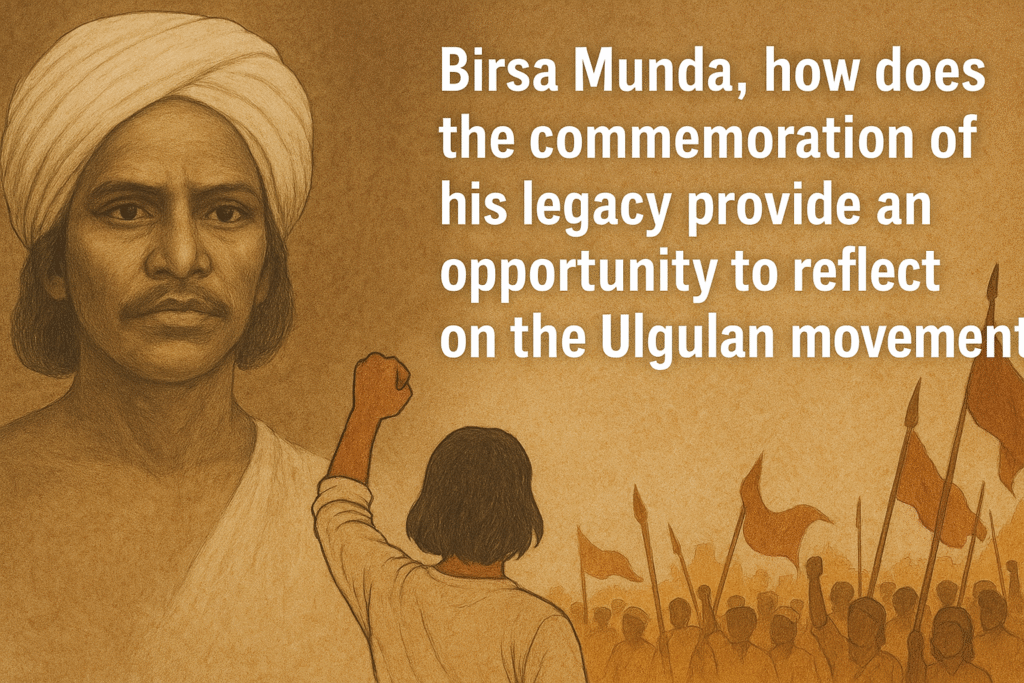
In the context of 150 years of Birsa Munda, how does the commemoration of his legacy provide an opportunity to reflect on the Ulgulan movement, its historical significance, the trajectory of its recognition, and the contemporary efforts to honour it? Discuss.
Introduction
India’s civilizational narrative is enriched by the contributions of its Adivasi communities, who represent the earliest inhabitants of the subcontinent. Among these legendary figures, Birsa Munda (1875–1900) stands out as a symbol of indigenous resistance and socio-cultural renewal. As India commemorates 150 years of Birsa Munda, it becomes a crucial moment to revisit the Ulgulan (Great Tumult) movement, reassess its significance in India’s freedom struggle, and examine contemporary efforts to honour his enduring legacy.
Historical Background & Causes of the Ulgulan Movement
1. Breakdown of the Traditional Khuntkatti System
- Tribal communities traditionally practiced Khuntkatti, a customary land-holding system based on collective ownership.
- Colonial intervention reversed this system through the Permanent Settlement Act (1793), which legalized the zamindari system.
- Outsiders (dikus) acquired ownership while tribal residents were relegated to tenants.
2. Economic Exploitation and Cultural Disruption
- Heavy taxes, bonded labour, missionary interference, and loss of forests created multilayered exploitation.
- This stripping of identity, resources, and autonomy laid the foundation for large-scale resistance.
3. Birth of the Ulgulan Movement (1899–1900)
Birsa Munda mobilized the Munda community by:
- Calling for Birsa Raj — a just political order
- Rejecting colonial taxes
- Reclaiming Jal, Jungle, Jameen
- Using guerrilla warfare to challenge British authority
His movement was revolutionary as it combined political, cultural, economic, and spiritual dimensions.
Historical Significance of the Ulgulan Movement
1. A Major Tribal Revolt Before 1857
Contrary to popular belief, tribal revolts began long before 1857, including:
- Tilka Manjhi (1784)
- Santhal Rebellion (1855)
- Bhil and Kol uprisings
Birsa’s uprising added a powerful ideological dimension to these movements.
2. Influenced Colonial Land Reforms
The movement forced the British to enact regulations protecting tribal land rights, particularly:
- Chotanagpur Tenancy Act (CNT Act), 1908
This landmark legislation recognized the historical injustice faced by tribals.
3. Cultural and Identity Revival
Birsa’s message restored:
- Tribal confidence
- Cultural pride
- Shared consciousness against injustice
He continues to inspire Adivasi political mobilization in modern India.
Trajectory of Recognition in Post-Independence India
1. Delayed Institutional Recognition
Despite his impact, Birsa Munda did not initially receive widespread national recognition.
2. Emergence as a National Icon
Over time, he became a symbol of:
- Anti-colonial resistance
- Indigenous identity
- Tribal empowerment
Roads, universities, airports, and museums across Jharkhand bear his name, reinforcing his national stature.
3. Janjatiya Gaurav Diwas (2021)
The Government of India declared 15 November (Birsa’s birth anniversary) as:
➤ Janjatiya Gaurav Diwas
This marked a major step in integrating tribal narratives into the national memory.
Contemporary Efforts to Honour Birsa Munda
1. Government Initiatives
Several programmes reflect a contemporary non-violent Ulgulan:
Education Initiatives
- Eklavya Model Residential Schools
- Adi Karmayogi Abhiyan
Health & Social Justice
- National Sickle Cell Elimination Mission
- Awareness campaigns for tribal health
Economic & Cultural Empowerment
- Venture Capital Fund for Tribal Entrepreneurs
- Adi Vaani digital empowerment
- Promotion of tribal art, craft, and heritage
2. Community Participation
Grassroots movements continue to preserve:
- Indigenous languages
- Traditional knowledge systems
- Ecological stewardship
The modern Ulgulan is a movement of empowerment, dignity, and opportunity.
Conclusion
Commemorating 150 years of Birsa Munda is not just about revisiting history—it is a reaffirmation of India’s commitment to preserving tribal culture, identity, and justice. The legacy of Ulgulan continues as a transformative movement, now guided by education, equity, environment, and empowerment. Birsa’s message remains a guiding light for creating an India that celebrates diversity while ensuring inclusive development.
Related Previous Year Questions
How did the colonial rule affect the tribals in India and what was the tribal response to the colonial oppression? (2023)
Examine how the decline of traditional artisanal industry in colonial India crippled the rural economy. (2017)
🔥 QUESTION 2
“Night-time minimum temperatures are more influenced by local conditions than large-scale geography.” Discuss the role of wind patterns, humidity, cloud cover, and land cover in influencing local climate, with an example.
Introduction
Local climate patterns often diverge from broader regional conditions due to micro-level variations in wind flow, humidity, land cover, and cloud formation. India’s recent weather anomalies, such as minimum temperatures in Gujarat’s Gandhinagar dropping below Naliya, illustrate how local conditions can overpower geographical expectations.
How Local Factors Influence Night-time Temperatures
1. Wind Patterns
- Winds redistribute heat and moisture.
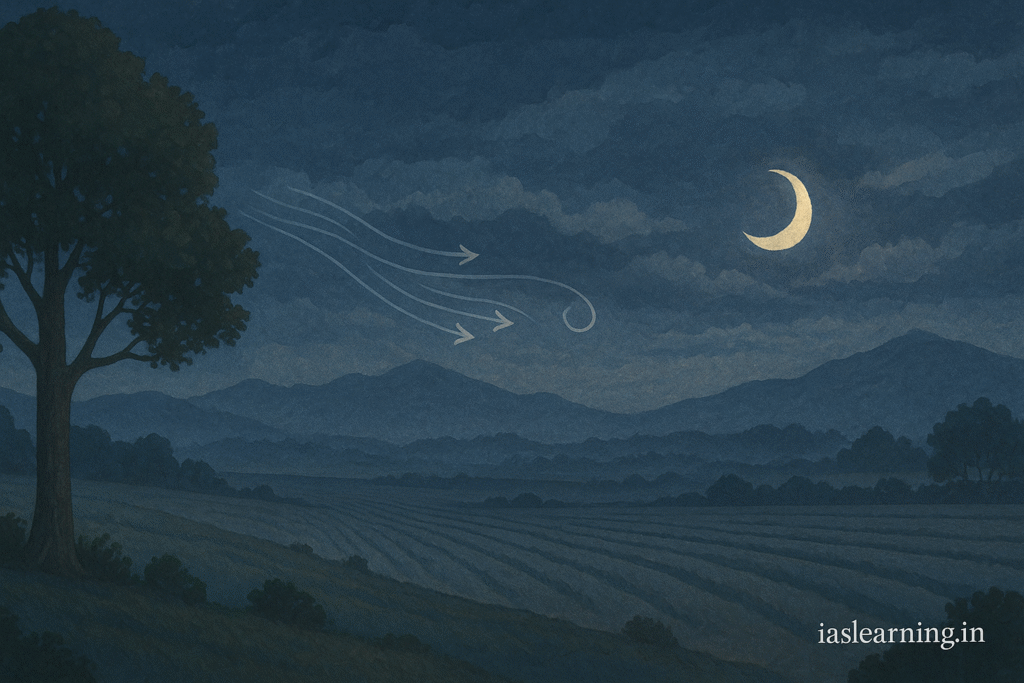
- Northeasterly winds bring cool, dry air → lower temperatures.
- Sea breeze in coastal areas keeps nights warmer than inland regions.
- Example:
- Light north-easterly winds cooled Gandhinagar significantly.
- Westerly winds kept Naliya warmer at night.
2. Cloud Cover
Clouds act like a thermal blanket.
- Clear skies:
- Promote rapid heat loss (radiative cooling) → colder nights.
- Cloudy skies:
- Trap outgoing heat → warmer nights.
Thus, two nearby cities can show drastically different minimum temperatures.
3. Humidity Levels
- High humidity → more water vapour → less radiative heat loss → warm nights.
- Dry air → rapid cooling → colder nights.
This explains why desert regions often have cold nights despite high daytime temperatures.
4. Land Cover & Urbanization
Surface characteristics influence heat storage:
Vegetated/Open areas
- Release heat rapidly at night
- Experience lower temperatures
Urban areas (Urban Heat Island effect)
- Concrete retains heat
- Nights remain warmer
Example:
Urban Ahmedabad stays warmer at night than rural areas in interior Gujarat.
Case Example: Gujarat Temperature Variation
- Gandhinagar recorded 13.8°C (below normal)
- Naliya recorded 14.7°C, despite being traditionally colder
IMD attributes this to:
- Clear skies + easterly winds in interior Gujarat
- Moisture and cloud cover reaching Naliya first due to western disturbances
This reinforces that local microclimate > large-scale geography.
Conclusion
Night-time temperature variation is a dynamic interplay of winds, humidity, cloud cover, and land characteristics, often overriding broader geographical expectations. Understanding these interactions enhances climate modeling, urban planning, and disaster preparedness. Such microclimate analysis is essential for a rapidly urbanizing and climatically vulnerable country like India.
Related Previous Year Questions
How are climate change and the sea level rise affecting the very existence of many island nations ? Discuss with examples. (2025)
What characteristics can be assigned to monsoon climate that succeeds in feeding more than 50 percent of the world population residing in Monsoon Asia? (2017)
❓ FAQs (SEO-Boosting Section)
1. Why is Birsa Munda important for UPSC?
He represents tribal resistance, land rights issues, and anti-colonial struggle—relevant for GS1 History and GS2 Governance.
2. What factors affect night-time temperatures?
Wind patterns, cloud cover, humidity, and land cover strongly influence minimum temperature.
3. Why practice UPSC answer writing weekly?
It develops structure, clarity, depth, and the ability to produce high-quality answers under time pressure.
Also Read: UPSC Mains Answer Practice GS Paper 1: Volcanic Eruptions & Tropical Forest Biodiversity
