


This article will help you revise the complete NCERT coverage of Ancient India quickly and effectively. It includes concise Indian History NCERT Part-1 Short Notes designed specially for UPSC aspirants.
BRICKS, BEADS AND BONES – The Harappan Civilisation
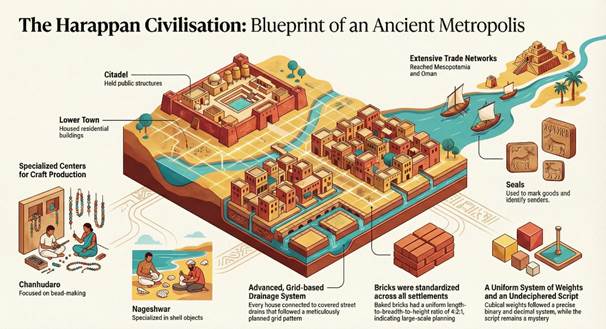
Nomenclature and Chronology
- The Harappan Civilisation is also referred to as the Indus Valley Civilisation or the Harappan culture.
- Archaeologists use the term “culture” for a distinctive group of objects (seals, beads, weights, stone blades, baked bricks) found within a specific geographical area and period.
- The civilization is generally dated between c. 2600 and 1900 BCE (Mature Harappan). Early and Late Harappan cultures preceded and succeeded this period.
Geographical Extent and Key Sites
- Distinctive Harappan objects have been found in areas as far apart as Afghanistan, Jammu, Baluchistan (Pakistan), and Gujarat.
- Harappa was the first site discovered. Other crucial sites include Mohenjodaro, Kalibangan (Rajasthan), Banawali (Haryana), Dholavira (Gujarat), and Lothal.
Urban Planning and Architecture (Mohenjodaro)
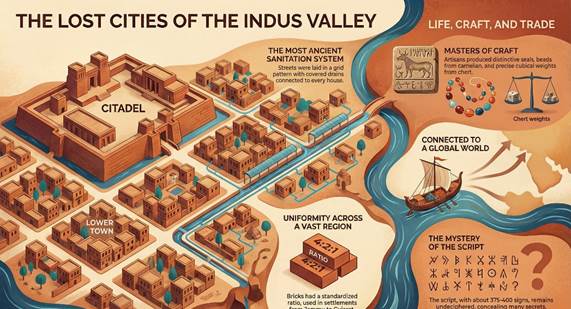
- The most unique feature was the development of urban centres. Settlements were typically divided into two sections: a smaller, higher Citadel and a larger, lower Lower Town.
- Buildings were constructed on mud brick platforms. Planning included standardized bricks (ratio of 1:2:4, used across all settlements) and mobilization of labor on a large scale.
Drainage System: A distinctive feature, following an approximate “grid” pattern of roads and streets intersecting at right angles. Every house connected to street drains.
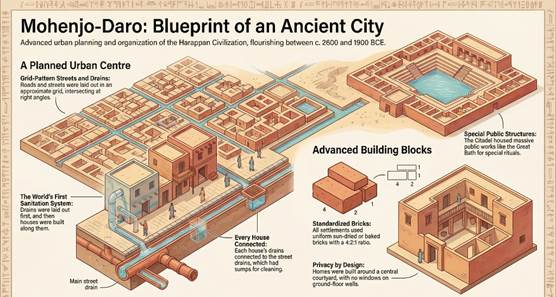
Domestic Architecture: Residential buildings centered on a courtyard. There was a concern for privacy (no ground-level windows, entrances did not offer a direct view of the interior). Mohenjodaro is estimated to have had about 700 wells.
Public Structures (Citadel): Structures for special public purposes included the Warehouse and the Great Bath. The Great Bath was a large, watertight rectangular tank, possibly used for a special ritual bath
Subsistence and Agriculture
Harappans ate a wide range of plant products (wheat, barley, lentil, chickpea, sesame, millets from Gujarat; rice was rare) and domesticated animals (cattle, sheep, goat, buffalo, pig).
- The use of the bull (and extrapolated use of oxen for ploughing) is indicated by seals and terracotta sculpture.
- Terracotta models of the plough were found at Cholistan and Banawali (Haryana).
- Evidence of a ploughed field with crisscross furrows (suggesting double cropping) was found at Kalibangan (associated with Early Harappan levels).
- Irrigation was likely used: traces of canals found at Shortughai (Afghanistan), and water reservoirs at Dholavira (Gujarat)
Craft Production and Trade
- Chanhudaro was a specialized center (less than 7 hectares) primarily devoted to craft production (bead-making, shell-cutting, seal-making, etc.).
- Materials used for beads included carnelian (red color achieved by firing), jasper, crystal, steatite (very soft stone), copper, bronze, gold, shell, and faience (precious, rare items). Specialised drills found at Chanhudaro, Lothal, and Dholavira.
- Nageshwar and Balakot were coastal settlements specialized in making shell objects (bangles, ladles).
- Procurement Strategies: Settlements were established near raw material sources (Shortughai for lapis lazuli; Lothal for carnelian, steatite, metal). Expeditions were sent to the Khetri region of Rajasthan (for copper) and South India (for gold).
- Distant Contacts: Contact with Oman (copper, indicated by nickel traces in artifacts and large Harappan jar coated in black clay found in Oman). Mesopotamian texts mention contact with regions: Dilmun (Bahrain), Magan (Oman), and Meluhha (possibly Harappan region)
Seals, Script, and Weights:
- Seals and Sealings: Used for long-distance communication; impression of the seal on wet clay affixed to a knot conveyed the identity of the sender.
- Script: Remains undeciphered. It had 375 to 400 signs, suggesting it was not alphabetical. It was written from right to left.
- Weights: Regulated exchanges using a precise system. Weights were generally cubical chert with no markings. Lower denominations were binary (1, 2, 4, 8…), while higher denominations followed the decimal system.
Authority and the End of the Civilization
The extraordinary uniformity of artifacts (pottery, seals, weights, bricks) suggests complex decisions were implemented and labor mobilized, pointing toward a possible single state (most plausible theory). A stone statue was labeled the “priest-king” based on Mesopotamian parallels. By c. 1800 BCE, most Mature Harappan sites in regions like Cholistan were abandoned, leading to a transformation into “Late Harappan” or “successor cultures”. Distinctive artifacts (seals, script, specialized beads) disappeared, along with long-distance trade. Causes included climatic change, deforestation, floods, and the shifting/drying up of rivers. The theory of a large-scale destruction or “invasion” (R.E.M. Wheeler, correlating with Rigveda’s puramdara) was later questioned by archaeologists like George Dales.
Also Read: Indian History Timeline : Ancient to Modern History Chronology
KINGS, FARMERS AND TOWNS – Early States and Economies (c. 600 BCE–600 CE)
New Period and Sources
The period from c. sixth century BCE is considered a major turning point, witnessing the emergence of early states, cities, coinage, iron use, Buddhism, and Jainism. Historians use inscriptions, texts, coins, and visual material. Epigraphy is the study of inscriptions.
Scripts and Decipherment
In the 1830s, James Prinsep deciphered Brahmi and Kharosthi, scripts used in the earliest inscriptions and coins. Most inscriptions referred to a king called Piyadassi (“pleasant to behold”); a few also mentioned Asoka. Earliest inscriptions were usually in Prakrit.
The Mahajanapadas
Early Buddhist and Jaina texts mention sixteen states known as mahajanapadas (e.g., Magadha, Koshala, Kuru). Most were ruled by kings; some were ganas or sanghas (oligarchies). Rulers were ideally expected to be Kshatriyas according to the Dharmasutras (Sanskrit texts, c. 6th century BCE onwards). They collected taxes/tribute and maintained standing armies/bureaucracies.
Magadhan Power
Magadha (present-day Bihar) became the most powerful mahajanapada (6th–4th centuries BCE) due to productive agriculture, access to iron mines, presence of elephants, and cheap water communication via the Ganga. Key rulers included Bimbisara, Ajatasattu, and Mahapadma Nanda. Capital shifted from Rajagaha (Rajgir) to Pataliputra (Patna) in the 4th century BCE.
The Mauryan Empire (c. 321 BCE–185 BCE)
Founded by Chandragupta Maurya. The most famous ruler, Asoka (c. 272/268–231 BCE), conquered Kalinga (coastal Orissa).
- Sources: Megasthenes’ account, the Arthashastra (attributed to Kautilya/Chanakya), and Asoka’s rock and pillar inscriptions.
- Administration: Five major political centers: Pataliputra (capital), Taxila, Ujjayini, Tosali, and Suvarnagiri. Taxila and Ujjayini were on important long-distance trade routes; Suvarnagiri was important for accessing gold mines of Karnataka.
- Military: Megasthenes noted a committee with six subcommittees coordinating military activity (navy, transport/provisions, foot-soldiers, horses, chariots, elephants).
- Dhamma: Asoka propagated dhamma (respect for elders, generosity, kindness to slaves). Dhamma mahamatta were appointed to spread the message.
Post-Mauryan Kingship
- Southern Chiefdoms: In Tamilakam, the Cholas, Cheras, and Pandyas chiefdoms emerged, known from Sangam texts. Chiefs received gifts (not taxes) and generally lacked regular armies.
- Kushanas: Ruled vast kingdom (Central Asia to NW India, c. 1st century BCE–1st century CE). Adopted the title devaputra (“son of god”) and installed colossal statues (Mathura/Afghanistan).
- Guptas (c. 4th Century CE onwards): History reconstructed from literature, coins, and prashastis (e.g., Prayaga Prashasti by Harishena, praising Samudragupta). Dependent on samantas (subordinate chiefs).
Agrarian Society and Land Grants
- Production Increase: Shift to iron-tipped ploughshare in fertile river valleys (Ganga/Kaveri) from c. 6th century BCE. Transplantation dramatically increased paddy production. Irrigation was utilized (wells, tanks, canals; e.g., Sudarshana Lake, Gujarat).
- Social Differences: Growing differentiation between landless laborers, small peasants, and large landholders. Gahapati (head of household) was a term for wealthy men/landholders. Tamil texts mentioned vellalar (large landowners), uzhavar (ploughmen), and adimai (slaves).
- Land Grants: Recorded on copper plates or stone, beginning in the early centuries CE. Grants were typically made to religious institutions or Brahmanas. Prabhavati Gupta (a queen) granted land, indicating that legal norms restricting women’s access to property were not uniformly applied. Agrahara grants exempted Brahmanas from paying revenue/dues.
Towns and Trade
Major towns (e.g., Pataliputra, Ujjayini, Puhar) were located along land or riverine routes of communication. Northern Black Polished Ware (NBPW), fine pottery, was used by the rich. Votive inscriptions record donations and mention various occupations (weavers, smiths, merchants). Guilds (shrenis) organized craft producers and merchants.
- Trade Routes: Criss-crossed the subcontinent, extending to Central Asia, West Asia, North Africa, and Southeast Asia. Successful merchants were known as masattuvan (Tamil) or setthis/satthavahas (Prakrit). Pepper, textiles, and medicinal plants were highly demanded by the Roman Empire.
- Coinage: Punch-marked coins (silver/copper, c. 6th century BCE onwards) were the earliest. Indo-Greeks issued the first coins with names and images of rulers (c. 2nd century BCE). Kushanas issued the first gold coins (c. 1st century CE), indicating high-value trade. Gupta rulers issued highly pure gold coins.
KINSHIP, CASTE AND CLASS – Early Societies (c. 600 BCE–600 CE)
The Mahabharata as a Source: The epic, composed over roughly 1,000 years (c. 500 BCE onwards), describes a feud between the Kauravas and Pandavas (Kuru lineage). The Critical Edition project (1919–1966) compiled common Sanskrit verses while documenting vast regional variations. The text contains narrative (stories) and didactic (prescriptions on social norms) sections.
Kinship and Marriage
- Patriliny: The ideal system, tracing descent from father to son. Succession was generally patrilineal in ruling dynasties.
- Exogamy: Marriage outside the kin was considered desirable for daughters; kanyadana (gift of a daughter) was a father’s duty.
- Dharmasutras and Dharmashastras: Codified social behavior (e.g., Manusmriti, c. 200 BCE–200 CE). They recognized eight forms of marriage.
- Gotra: Brahmanical practice (c. 1000 BCE onwards). Rules: women adopt husband’s gotra upon marriage, and marriage within the same gotra was forbidden.
- Satavahana Exception: Satavahana rulers were identified by metronymics (e.g., Gotami-puta). Women often retained their father’s gotra and the Satavahanas practiced endogamy (marriage within the kin group), running contrary to Brahmanical rules.
The Varna System
Social order was based on varna and claimed to be divinely ordained (cited the Purusha sukta of the Rigveda).
- Brahmanas: Study/teach Vedas, perform sacrifices, give/receive gifts.
- Kshatriyas: Warfare, protect, administer justice.
- Vaishyas: Agriculture, pastoralism, trade.
- Shudras: Serving the three higher varnas
Challenges to Varna
- Kingship: Political power did not always depend on birth as a Kshatriya. The Shungas/Kanvas were Brahmanas. Shaka rulers (Central Asian) were called mlechchhas (barbarians), yet patronized Sanskritic traditions.
- Jatis: Unlimited in number, based on birth, used to classify occupational groups (like the suvarnakara, goldsmith) or forest dwellers (like nishadas). Jatis sometimes organized into shrenis (guilds).
- Untouchables: Categories deemed “polluting” (e.g., handling corpses) were classified as chandalas. They were forced to live outside villages. The Chinese pilgrim Fa Xian (c. 5th century CE) noted they had to sound a clapper to warn people of their approach.
Access to Resources
- Gender: Men primarily controlled property (land, cattle, money). The paternal estate was inherited by sons. Women were allowed to keep stridhana (gifts received at marriage), which their children inherited.
- Varna and Wealth: Brahmanical texts suggested Brahmanas and Kshatriyas would be the wealthiest.
- Buddhist Critique: Buddhists rejected claims to status based on birth. The Sutta Pitaka offered a theory of the origin of kingship through a social contract (mahasammata), chosen by the people and paid with taxes.
- Tamilakam: Sangam texts showed that respected men (chiefs) were expected to share wealth (generosity emphasized over mere accumulation)
THINKERS, BELIEFS AND BUILDINGS – Cultural Developments (c. 600 BCE–600 CE)
Context and Early Traditions
The mid-first millennium BCE was characterized by thinkers (Mahavira, Buddha) questioning existing traditions. The Rigveda (c. 1500–1000 BCE) contained hymns for deities (Agni, Indra, Soma). Later Vedic traditions (c. 1000–500 BCE) included elaborate sacrifices (rajasuya, ashvamedha) performed by chiefs and priests. The Upanishads (c. 6th century BCE onwards) explored concepts like life after death, rebirth, and ultimate reality.
Jainism: Associated with Vardhamana Mahavira (6th century BCE), preceded by 23 tirthankaras. Central teaching: the entire world is animated (even stones, water). The core principle is Ahimsa (non-injury). Salvation is achieved through asceticism, penance, and monastic life to free oneself from karma. Monks took five vows, including celibacy and non-possession of property.
Buddhism: Siddhartha (the Buddha) was born to the Sakya clan chief. After witnessing sickness, old age, and death, he renounced worldly life and attained enlightenment, becoming the Buddha
- Teachings (Sutta Pitaka): The world is transient (anicca) and soulless (anatta); sorrow (dukkha) is intrinsic. Liberation is achieved through a path of moderation (between extremes) and individual effort. The goal is Nibbana (extinguishing the ego/desire).
- The Sangha: An organization of monks (bhikkhus) and nuns (bhikkhunis). Women were admitted later, initiated by Mahapajapati Gotami (Buddha’s foster mother). Women who achieved liberation were known as theris. Functioning was based on consensus (like ganas/sanghas). Buddhist texts are compiled in the Tipitaka (Three Baskets): Vinaya Pitaka (rules for sangha), Sutta Pitaka (teachings), and Abhidhamma Pitaka (philosophical matters).
Stupas (Buddhist Monuments)
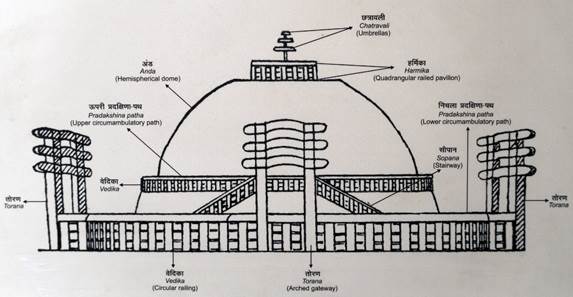
Stupas were mounds built over the relics (bodily remains or objects used) of the Buddha, making them emblems of the Buddha and Buddhism. The Ashokavadana states that Asoka distributed relics and ordered the construction of stupas.
- Structure: Originated as a semi-circular mound (anda). Features include the harmika (balcony-like abode of the gods), the yashti (mast) surmounted by a chhatri (umbrella), and a railing separating the sacred space. Worshippers performed pradakshina (circumambulation) clockwise.
- Funding: Donations recorded on railings/pillars came from kings (Satavahanas), guilds (e.g., ivory workers at Sanchi), and ordinary individuals/monastics.
- Sanchi vs. Amaravati: The stupa at Amaravati was largely destroyed due to early removal of sculptures by local rulers and British officials (Elliot marbles). Sanchi was preserved in situ (on the spot) largely due to the foresight and financial support of the Begums of Bhopal (Shahjehan Begum and Sultan Jehan Begum).
Sculptural Traditions and Interpretation
Early sculptors often represented the Buddha via symbols rather than in human form.
- Symbols: Empty seat (meditation), the Stupa (mahaparinibbana), and the Wheel (first sermon at Sarnath).
- Popular Motifs: The Shalabhanjika (woman whose touch causes trees to flower) was used as an auspicious symbol. Gajalakshmi (goddess of good fortune) was also common.
- Ajanta: Famous cave paintings depict stories from the Jatakas and courtly life.
New Religious Developments (Post-1st Century CE)
- Mahayana Buddhism: Belief shifted to the concept of a saviour. Bodhisattas (compassionate beings who delay nibbana to help others) emerged, leading to the worship of images. This was called Mahayana (“great vehicle”); the older tradition was called Hinayana or Theravada.
- Puranic Hinduism: Growth of Vaishnavism (Vishnu) and Shaivism (Shiva). Emphasis on bhakti (devotion). Vaishnavism recognized ten avatars of Vishnu. Stories and beliefs were codified in the Puranas (simple Sanskrit verse, accessible to women and Shudras).
- Temples: The first temples (early centuries CE) housed images in a small square room called the garbhagriha. A tall structure, the shikhara, was built over the shrine. The tradition of artificial caves (e.g., those carved by Asoka for the Ajivika sect, 3rd century BCE) culminated in structures like the monolithic Kailashnatha Temple at Ellora (8th century).
Also Read: History Of Vijayanagara & Ruler’s UPSC