

Relevance for BPSC / UPSC / Civil-Service Exams & General Studies
Given your preparation trajectory (you are preparing for BPSC, and interested in general science, social issues, governance, etc.), here is why the New Labor Code 2025 are important for you:
- Prelims & Mains — Polity / Governance / Economy / Labour & Employment: Understanding consolidation of labour laws, new statutory minimum wage regime, social security expansion, rights of workers — this is directly relevant for syllabus areas like labour welfare, social justice, economic reforms.
- Essay & GS-3 answers: For essay topics like “Labour reforms in India”, “Formalisation of workforce”, “Worker welfare vs Ease of doing business”, “Gig economy and social security”, these codes provide current, real-world context.
- Case studies / Data interpretations: The shift from 29 laws to 4 codes, inclusion of gig workers, changes in layoff norms, uniform minimum wage — useful for analysing socio-economic policy changes.
- Understanding Government of India’s approach: The codes reflect a philosophical shift in state’s role — from rigid regulation to “facilitation”, aligning with global labour trends. Understanding this helps in critically evaluating policy direction.
Background & Rationale
- India historically had 29 central labour laws, many dating back to colonial times or early post-Independence period. The framework was fragmented, complex, and often inconsistent across sectors and states
- The idea to rationalize and consolidate laws was recommended by the Second National Commission on Labour (SNCL), constituted in 1999
- The principal aims: simplify compliance and regulatory burden (ease of doing business), standardize laws across sectors and states, modernize labour jurisprudence, and respond to evolving forms of employment (contractual work, gig/platform work, unorganised sector
- After years of drafting and debate, the Government finally notified the four Codes with effect from 21 November 2025.
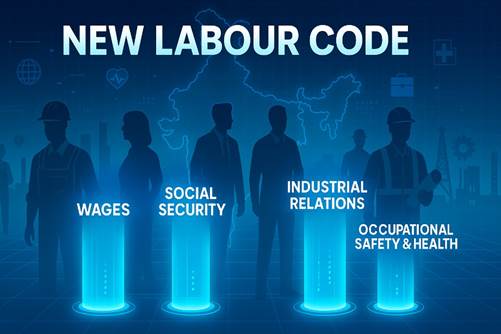
The Four Labour Codes: What They Are
| Code | Focus / Scope | What old laws does it subsume? |
| Code on Wages, 2019 | Wages, minimum wages, timely payment, bonus, equal remuneration | Replaces: Payment of Wages Act 1936; Minimum Wages Act 1948; Payment of Bonus Act 1965; Equal Remuneration Act 1976 |
| Industrial Relations Code, 2020 | Trade unions, conditions of employment, dispute resolution, layoffs/ retrenchment / closure provisions | Replaces: Trade Unions Act 1926; Industrial Disputes Act 1947; Industrial Employment (Standing Orders) Act 1946. |
| Code on Social Security, 2020 | Social security: PF/ pension/ ESI/ maternity/ gig workers/ unorganised workers’ welfare | Consolidates multiple social-security and welfare laws (earlier spread across many enactments) |
| Occupational Safety, Health and Working Conditions Code, 2020 (OSHWC Code) | Occupational safety, health, working conditions, welfare of workers, working hours, factory/ establishment standards | Replaces multiple older laws related to factories, mines, dock work, plantation safety etc. |
Key Features and Provisions under the New Codes
Here are the major changes and new provisions introduced under the Labour Codes (effective from 21 Nov 2025) — what they mean for workers, employers, and the labour ecosystem.
Wages & Remuneration (Code on Wages)

- Universal statutory minimum wage: All workers — whether in organised or unorganised sectors — are entitled to a minimum wage as per the Code.
- Timely payment of wages becomes mandatory; timely wage payment to all workers.
- Definition of “wages” standardised — uniform definition across sectors.
- “Basic pay” floor in CTC: There is a new rule that allowances (like HRA, conveyance etc.) cannot exceed 50% of total remuneration. Excess part if any may be added to basic wage (thus increasing PF, gratuity base) — this may reduce take-home pay but ensures higher retirement/social contributions.
Employment Relations, Hiring & Retrenchment (Industrial Relations Code)

- Higher threshold for layoffs/retrenchment/closure: Companies with up to 300 employees can lay off or retrench without prior government approval (previous threshold was 100).
- Fixed-term employment (FTE): Employers can hire workers on fixed-term contracts with entitlements similar to permanent employees (wages, benefits, social security).
- Strikes / industrial action regulations tightened: The definition of “strike” is modified — e.g. if more than 50% of workers take simultaneous casual leave, it may be treated as a strike. Also, workers must give 14-60 days’ notice before strike.
- Faster dispute resolution mechanisms — streamlined, with fewer overlapping laws.
Social Security & Welfare (Social Security Code)

- Social security coverage expanded to include unorganised sector workers, contract workers, gig/platform workers, seasonal and migrant workers.
- Benefits such as provident fund (PF), insurance, pension/old-age benefits, maternity benefits, etc. now have more universal scope under the Code
- For fixed-term employees (FTEs), eligibility for gratuity and other benefits becomes possible — earlier many contract workers were excluded.
Occupational Safety, Health & Working Conditions (OSHWC Code)

- Uniform safety, health and working-condition standards across sectors (factories, mines, docks, plantations, etc.) — replacing outdated, fragmented laws.
- Provisions for safer workplaces, better welfare facilities (drinking water, sanitation, rest areas), safety equipment, protective measures, especially in hazardous industries — expected to improve worker health and safety
- Flexibility in working hours: daily working hours could vary between 8 and 12 hours (subject to weekly cap of 48 hours). Overtime must be paid at least double the normal wage rate.
- Formal employment documentation: all workers to be given appointment letters specifying designation, wages, social security — promoting transparency and formalisation of employment.
Additional Features & Reforms — What the New Framework Brings
- Uniformity and simplification: A single statutory code for each domain reduces multiplicity of overlapping laws; easier compliance for employers; easier enforcement and clarity for workers.
- Gender-neutral, non-discriminatory provisions: The Codes prohibit wage discrimination on grounds of gender (and also extend to transgender persons), require equal pay for equal work
- Better coverage for unorganised, gig, contract and platform workers — groups earlier outside formal labour laws.
- Formalisation of workforce: Mandatory appointment letters, social security benefits, safety norms — helps bring more workers under legal protection.
Who Stands to Benefit — Potential Gains
The new labour codes are likely to bring important benefits to many kinds of workers and employers. Some of the key beneficiaries:
- Unorganised, casual, contractual, fixed-term & gig workers — they will now have access to minimum wages, formal appointment letters, social security, provident fund/insurance, overtime pay, safety protections
- Women workers and marginalized groups — through equal pay provisions, non-discrimination, safety norms; also better access to social security and maternity benefits.
- Employers and industries (especially MSMEs, small units, start-ups) — through simplified compliance, unified laws, easier hiring/firing norms, flexibility in labour management
- Overall formalisation of labour force — better record-keeping (appointment letters), more workers in formal sector (PF, ESI, gratuity), improved labour welfare and safety — contributing to long-term social security and industrial growth.
Given India’s large informal and unorganised workforce, these reforms could, over time, significantly uplift labour protections and welfare, especially for vulnerable workers.
Concerns, Criticisms and Challenges
Despite the potential benefits, the new labour codes have generated criticism and concern, mainly from trade unions, labour rights activists, and some state governments. Key points of contention:
- Weaker job security / easier layoffs: Raising the threshold for layoff/ retrenchment approval to 300 employees (from 100) gives employers more flexibility — but critics argue this reduces workers’ protection and may lead to job insecurity.
- Fixed-term employment (FTE): While beneficial for flexibility, FTE may also lead to increased casualisation of workforce, with employers hiring on fixed-term contracts instead of permanent jobs. Critics fear this undermines long-term stability and reduces bargaining power of workers
- Dilution of enforcement mechanisms: The new “Inspector-cum-Facilitator” model replaces older inspector-based regimes — some see this as shift away from strict enforcement toward facilitation, potentially reducing oversight.
- Take-home salary impact: Because allowances over 50% of CTC may be counted as basic wage (thus increasing PF, gratuity contribution), many employees may see reduction in net take-home pay — especially if employer passes full deduction burden to employee.
- Implementation & State-level adoption: While Central Code is notified, actual rules require state-level adoption and notification. Also, existing laws remain operational until full rules under the new Codes come into force — transitional ambiguity remains.
- Concerns on labour rights, collective bargaining and union strength: Stricter norms for strikes, easier layoffs and fixed-term contracts — critics say this weakens collective bargaining, union power and long-term worker security.
Hence, while the Codes mark a big reform, real-world outcomes will depend heavily on implementation, state rules, enforcement, and how employers and workers adapt.
Important Facts & Figures
| Labour Code | Year Passed | Old Acts Merged | Total Acts Merged |
| Code on Wages | 2019 | Payment of Wages Act, Minimum Wages Act, Payment of Bonus Act, Equal Remuneration Act | 4 |
| Industrial Relations (IR) Code | 2020 | Trade Unions Act, Industrial Disputes Act, Standing Orders Act | 3 |
| Occupational Safety, Health & Working Conditions (OSHWC) Code | 2020 | Factory Act, Mines Act, Dockworkers Act, + others | 13 |
| Social Security Code | 2020 | EPF Act, ESI Act, Maternity Benefit Act, Gratuity Act + others | 9 |
| Total Acts merged into 4 Codes | — | — | 29 Acts |
Key Numerical Provisions (Very Important)
| Provision | Key Figure / Limit |
| Maximum allowance component in salary | 50% of total pay (rest becomes basic pay) |
| Maximum weekly working hours | 48 hours |
| Possible daily working hours | 8–12 hours with consent |
| Overtime rate | At least 2× normal wage |
| Paid leaves / strike notice (public utility services) | 14–60 days’ notice mandatory |
| Government approval needed for layoffs? | Only if workforce >300 employees |
| Gratuity for fixed-term employees | Eligible on pro-rata basis (earlier 5-year rule) |
| Mandatory appointment letter | For all employees in all establishments |
| Mandatory health check-up | Annually for certain categories of workers |
Who Gets Covered? (Numbers & Categories)
| Category of Workers | Coverage Under New Codes |
| Organised-sector workers | Fully covered under all 4 codes |
| Unorganised workers | Brought under Minimum Wages + Social Security |
| Gig workers | First time legally recognised under Social Security Code |
| Platform workers | Covered under welfare schemes / contributions |
| Inter-state migrant workers | Better safety + travel allowance + registration |
| Contract labour | Clearer rules + welfare + working conditions |
Timeline for Labour Reforms (Fast Revision)
| Year | Event |
| 1999 | Second National Commission on Labour set up |
| 2002 | SNC Report recommends codification |
| 2019 | Code on Wages passed |
| 2020 | IR Code, OSHWC Code, Social Security Code passed |
| 2025 (Nov) | Central Govt notifies implementation (major provisions) |
Read More: Why Europeans Came to India?