| Syllabus: GS PAPER 3 – Technology Missions; Infrastructure: Energy; Indian Economy and issues relating to Planning, Mobilization of Resources, Growth, Development and Employment; Inclusive Growth and issues arising from it; Conservation, Environmental Pollution and Degradation; Geography of India and the World. |
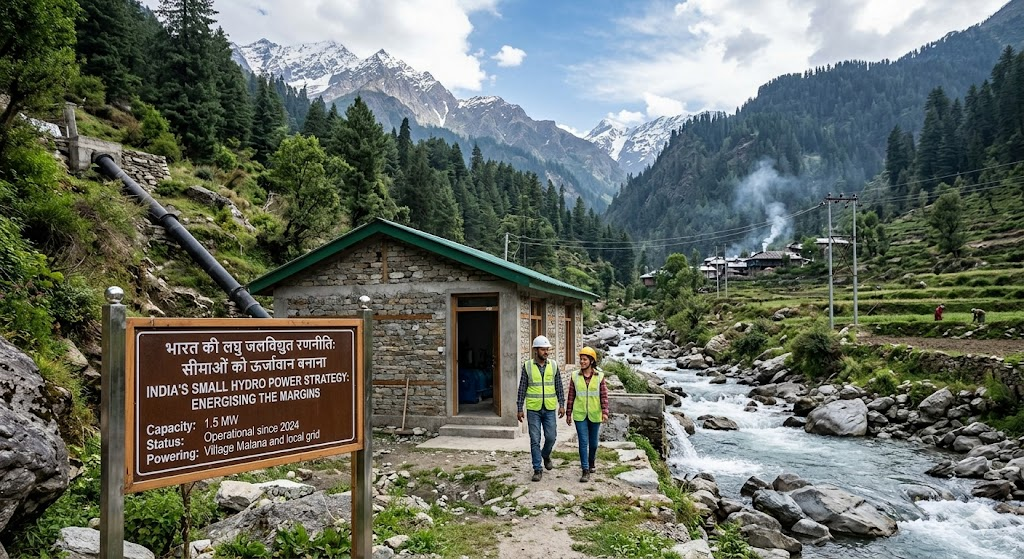
| India’s Small Hydro Power Strategy: Energising the Margins |
| Current Status of Small Hydro Power in India | India is steadily advancing its small hydro power (SHP) sector as part of a broader push toward reliable, decentralised, and clean energy. Unlike intermittent renewable sources, small hydro provides firm, round-the-clock (RTC) electricity, making it especially valuable for grid stability and remote energy access. Key figures as of early 2026: Total identified SHP potential: 21,133.61 MW across 7,133 sitesInstalled capacity: ~5,171 MW (approximately 24.5% of total potential)Untapped potential: ~15,960 MW, representing a major opportunity for accelerated development In April 2026, the Union Cabinet approved the Small Hydro Power (SHP) Development Scheme for FY 2026–27 to FY 2030–31, with a total outlay of ₹2,584.60 crore. The scheme targets the addition of approximately 1,500 MW of new SHP capacity, with a strong focus on hilly regions and North Eastern States. The scheme is projected to: Attract investments of around ₹15,000 crore in the SHP sectorGenerate approximately 51 lakh person-days of employment during the construction phaseSupport preparation of Detailed Project Reports (DPRs) for at least 200 projects, with ₹30 crore allocated for pipeline development Small hydro projects (1–25 MW capacity) are administered by the Ministry of New and Renewable Energy (MNRE), distinct from large hydro projects (above 25 MW) under the Ministry of Power. |
| Significance of Small Hydro Power for Sustainable Development | Decentralised and Efficient Power Supply: Located near demand centres, SHP projects minimise transmission losses and improve voltage stability in geographically challenging areas including border and hilly regions.Unlike solar and wind, SHP provides firm, round-the-clock power, making it a critical complement to intermittent renewables for grid resilience. Clean and Cost-Effective Energy: SHP generates electricity without fuel consumption or greenhouse gas emissions, offering a sustainable and economically viable long-term solution.Run-of-the-river projects—which use natural water flow without large dams—have minimal ecological disruption and low operational costs over their long lifespans. Driver of Rural and Inclusive Development: Improved electricity access in underserved areas catalyses infrastructure development, agricultural productivity, and local economic growth.SHP projects in tribal, hilly, and remote regions directly reduce dependence on diesel generators and conventional fuels, lowering household and community energy costs. Employment and Livelihood Generation: SHP creates both direct construction employment and sustained operation and maintenance jobs, particularly in rural and remote areas where formal employment opportunities are scarce. Environmental Sustainability: With minimal land requirements, negligible displacement, and low ecological footprint, SHP stands apart from large hydro projects in its social and environmental compatibility.Canal-based and dam-toe SHP projects repurpose existing irrigation and water infrastructure, further reducing environmental impact. Strategic Importance for National Goals: SHP contributes directly to Atmanirbhar Bharat by promoting indigenous plant and machinery, and to Net Zero 2070 by adding clean, firm capacity to the national grid.For India’s North Eastern and border states, SHP is often the most feasible pathway to energy security given terrain constraints and limited grid connectivity. |
| Small Hydro Power Potential Across India | India’s SHP potential is geographically distributed across five regions, each offering distinct strengths and development pathways:  Northern Region – 7,978 MW (~38% of national potential): Himachal Pradesh (3,460 MW), Uttarakhand (1,664 MW), Jammu & Kashmir (1,312 MW), Ladakh (395 MW)Driven by perennial rivers, mountainous terrain, and favourable hydrology; despite a strong resource base, utilisation levels remain moderate, indicating substantial untapped capacity North-Eastern Region – 3,262 MW (~15%): Arunachal Pradesh (2,064.92 MW) leads, followed by Sikkim (266.64 MW), Meghalaya (230.05 MW), Assam (201.99 MW), Nagaland (182.18 MW), Mizoram (168.90 MW), Manipur (99.95 MW), and Tripura (46.86 MW)Key frontier for decentralised and off-grid energy; the SHP scheme’s higher financial assistance (₹3.6 crore/MW or 30% of project cost) specifically targets this region Southern Region – 5,490 MW (~26%): Karnataka (3,726.49 MW) accounts for ~68% of regional potential, followed by Kerala (276.52 MW) and Tamil Nadu (123.05 MW)Relatively higher utilisation levels; well-positioned for further scale-up through optimisation and integration with other clean energy sources Western Region – 2,963 MW (~14%): Maharashtra leads (786.46 MW), followed by Rajasthan and GujaratNotable for canal-based and dam-toe projects that leverage existing irrigation infrastructure for cost-effective SHP deployment Eastern Region – 1,440 MW (~7%): Bihar (526.98 MW) and West Bengal (392.06 MW) lead the regionStrategically important for decentralised rural and tribal development; currently underutilised with significant scope for expansion Northern Region – 7,978 MW (~38% of national potential): Himachal Pradesh (3,460 MW), Uttarakhand (1,664 MW), Jammu & Kashmir (1,312 MW), Ladakh (395 MW)Driven by perennial rivers, mountainous terrain, and favourable hydrology; despite a strong resource base, utilisation levels remain moderate, indicating substantial untapped capacity North-Eastern Region – 3,262 MW (~15%): Arunachal Pradesh (2,064.92 MW) leads, followed by Sikkim (266.64 MW), Meghalaya (230.05 MW), Assam (201.99 MW), Nagaland (182.18 MW), Mizoram (168.90 MW), Manipur (99.95 MW), and Tripura (46.86 MW)Key frontier for decentralised and off-grid energy; the SHP scheme’s higher financial assistance (₹3.6 crore/MW or 30% of project cost) specifically targets this region Southern Region – 5,490 MW (~26%): Karnataka (3,726.49 MW) accounts for ~68% of regional potential, followed by Kerala (276.52 MW) and Tamil Nadu (123.05 MW)Relatively higher utilisation levels; well-positioned for further scale-up through optimisation and integration with other clean energy sources Western Region – 2,963 MW (~14%): Maharashtra leads (786.46 MW), followed by Rajasthan and GujaratNotable for canal-based and dam-toe projects that leverage existing irrigation infrastructure for cost-effective SHP deployment Eastern Region – 1,440 MW (~7%): Bihar (526.98 MW) and West Bengal (392.06 MW) lead the regionStrategically important for decentralised rural and tribal development; currently underutilised with significant scope for expansion  |
| Key Features of the SHP Development Scheme (2026–31) | Financial Support Structure: North Eastern States and International Border Districts: ₹3.6 crore per MW or 30% of project cost (whichever is lower), subject to a ceiling of ₹30 crore per projectOther Locations: ₹2.4 crore per MW or 20% of project cost (whichever is lower), capped at ₹20 crore per project Capacity and Investment Targets: Addition of approximately 1,500 MW of new SHP capacity across the countryExpected to attract ₹15,000 crore in private and public investment in the SHP sector Pipeline Development and DPR Support: Support for preparation of Detailed Project Reports (DPRs) for a minimum of 200 projects₹30 crore allocated separately to assist central and state agencies in building a strong future project pipeline Employment Generation: ~51 lakh person-days of employment during construction phaseSustained employment in operation and maintenance of projects in rural and remote regions Indigenisation and Atmanirbhar Bharat: Promotes use of indigenous plant and machinery, strengthening domestic manufacturing and supply chains in the renewable energy equipment sector Scheme Duration: FY 2026–27 to FY 2030–31 (five years), with a total outlay of ₹2,584.60 crore |
| Impacts of India’s Small Hydro Power Push | Energy Security and Grid Resilience: Addition of 1,500 MW of firm, RTC capacity will directly strengthen grid stability, particularly as India’s share of intermittent solar and wind power rises.SHP projects in hilly and North Eastern states will reduce dependence on long-distance transmission lines, making local grids more resilient to disruptions. Inclusive Growth and Regional Equity: By prioritising the North East and border districts with higher financial assistance, the scheme addresses historical energy access deficits in India’s most underserved regions.Improved electricity access will catalyse growth in agriculture, small industries, education, and healthcare in remote communities. Industrial and Manufacturing Growth: The focus on indigenous equipment manufacturing will stimulate growth in the domestic hydro equipment industry, reducing import dependence and building long-term supply chain resilience.₹15,000 crore of expected investment will generate significant multiplier effects across construction, equipment, logistics, and services sectors. Environmental Co-benefits: Replacing diesel generators and coal-based power with SHP in remote areas will deliver measurable reductions in carbon emissions and local air pollution.Run-of-the-river and canal-based projects avoid large-scale flooding, preserving forest cover, biodiversity, and riverine ecosystems Contribution to National Climate Commitments: SHP expansion contributes to India’s 500 GW non-fossil capacity target by 2030 and its Nationally Determined Contributions (NDCs) under the Paris Agreement.As a firm renewable source, SHP complements solar and wind to achieve round-the-clock clean power — a critical requirement for India’s Net Zero 2070 pathway. |
| Challenges in Small Hydro Power Development | Hydrological and Geological Risks: SHP projects in hilly terrains are vulnerable to flash floods, landslides, and sedimentation, which can damage infrastructure, reduce plant efficiency, and increase O&M costs.Accurate long-term hydrological data is often unavailable in remote areas, increasing project risk during planning and financing stages Financial Viability and Private Investment Barriers: High upfront capital costs, long gestation periods, and limited revenue certainty make SHP projects less attractive to private investors without strong policy guarantees and concessional financing.Weak financial health of state DISCOMs — with accumulated losses exceeding ₹6 lakh crore as of 2024–25 — leads to delayed payments and increased project risk for developers. Land Acquisition and Environmental Clearances: Even small hydro projects can face delays in land acquisition and forest clearances, particularly in ecologically sensitive hilly and North Eastern regions.Community resistance, especially in tribal areas, requires robust social impact assessment and Free, Prior, and Informed Consent (FPIC) processes that add to project timelines. Infrastructure and Connectivity Constraints: Remote project sites often lack road connectivity, grid access, and skilled workforce, raising construction costs significantly and complicating equipment logistics.Evacuation infrastructure — especially inter-state transmission lines — frequently lags behind generation capacity, limiting power off-take from completed projects. Regulatory and Institutional Fragmentation: SHP projects require clearances from multiple agencies — environment, forest, water resources, revenue — creating coordination challenges and procedural bottlenecks that delay project execution.Inconsistent state-level policies on water allocation, tariffs, and wheeling charges create regulatory uncertainty for developers operating across states. Climate Change Vulnerability: Changing precipitation patterns, glacial retreat, and increased weather variability due to climate change pose long-term risks to the hydrology of sites in the Himalayas and North East, potentially affecting energy generation projections. |
| Way Forward | Strengthen Single-Window Clearance Mechanisms: Establish a unified digital clearance portal for SHP projects integrating environment, forest, water, and revenue approvals to reduce procedural delays. International example: Norway’s streamlined licensing process for small hydro has enabled rapid deployment while maintaining environmental standards, a model India can adapt through state-level coordination.Expand Concessional Finance and Risk-Sharing Instruments: Scale up green bonds, blended finance mechanisms, and credit guarantees through institutions like IREDA and NABARD to de-risk SHP investments. International example: Nepal’s hydropower development has leveraged multilateral concessional finance from ADB and World Bank to attract private capital in difficult terrains — a pathway relevant to India’s North Eastern states.Integrate SHP with Smart Mini-Grids: Develop SHP-anchored hybrid mini-grids combining small hydro with solar and battery storage to provide reliable 24×7 power in off-grid communities. International example: Bhutan has successfully deployed hybrid micro-hydro systems in remote valleys, offering a proximate model for India’s North Eastern border areas.Build a Dedicated Skilling Ecosystem: Establish hydro power skill development centres in partnership with ITIs and polytechnics in Himachal Pradesh, Uttarakhand, and the North Eastern states to train turbine technicians, civil engineers, and O&M personnel.Promote Canal-Based and Dam-Toe Projects: Prioritise canal fall and dam-toe SHP projects on existing irrigation infrastructure to minimise land acquisition, environmental clearances, and community displacement. International example: China has extensively utilised existing irrigation canals for small hydro generation, adding thousands of MW with minimal social disruption — a scalable model for India’s Western and Eastern regions.Align DISCOM Reforms with SHP Offtake Agreements: Link SHP tariff agreements to DISCOM financial restructuring programmes to ensure timely payment and investor confidence. Long-term Power Purchase Agreements (PPAs) with clear escalation clauses will be essential for attracting private capital to remote project sites.Leverage Climate Finance for North Eastern Development: Position SHP projects in North Eastern states as climate finance-eligible assets under Green Climate Fund, bilateral climate partnerships, and carbon credit mechanisms to supplement domestic budgetary support and accelerate deployment. |
| Conclusion | India’s Small Hydro Power Development Scheme (2026–31) represents a focused and timely policy intervention to harness one of the country’s most underutilised clean energy assets. With an outlay of ₹2,584.60 crore targeting 1,500 MW of new capacity, the scheme goes beyond megawatts — it is a blueprint for inclusive, decentralised, and sustainable development in India’s most underserved geographies. Small hydro power occupies a unique space in India’s energy transition: it is firm where solar and wind are intermittent, local where large hydro is centralised, and sustainable where thermal power is polluting. By combining targeted financial support, pipeline development, and indigenous manufacturing promotion, the scheme positions SHP as both an energy security asset and a rural development catalyst As Jawaharlal Nehru once described dams and power projects as the “temples of modern India”, small hydro power today carries forward that vision — not through monumental structures, but through thousands of small, community-scale projects that quietly illuminate the margins of the nation, strengthen grid resilience, and contribute to a cleaner, more self-reliant India. |