

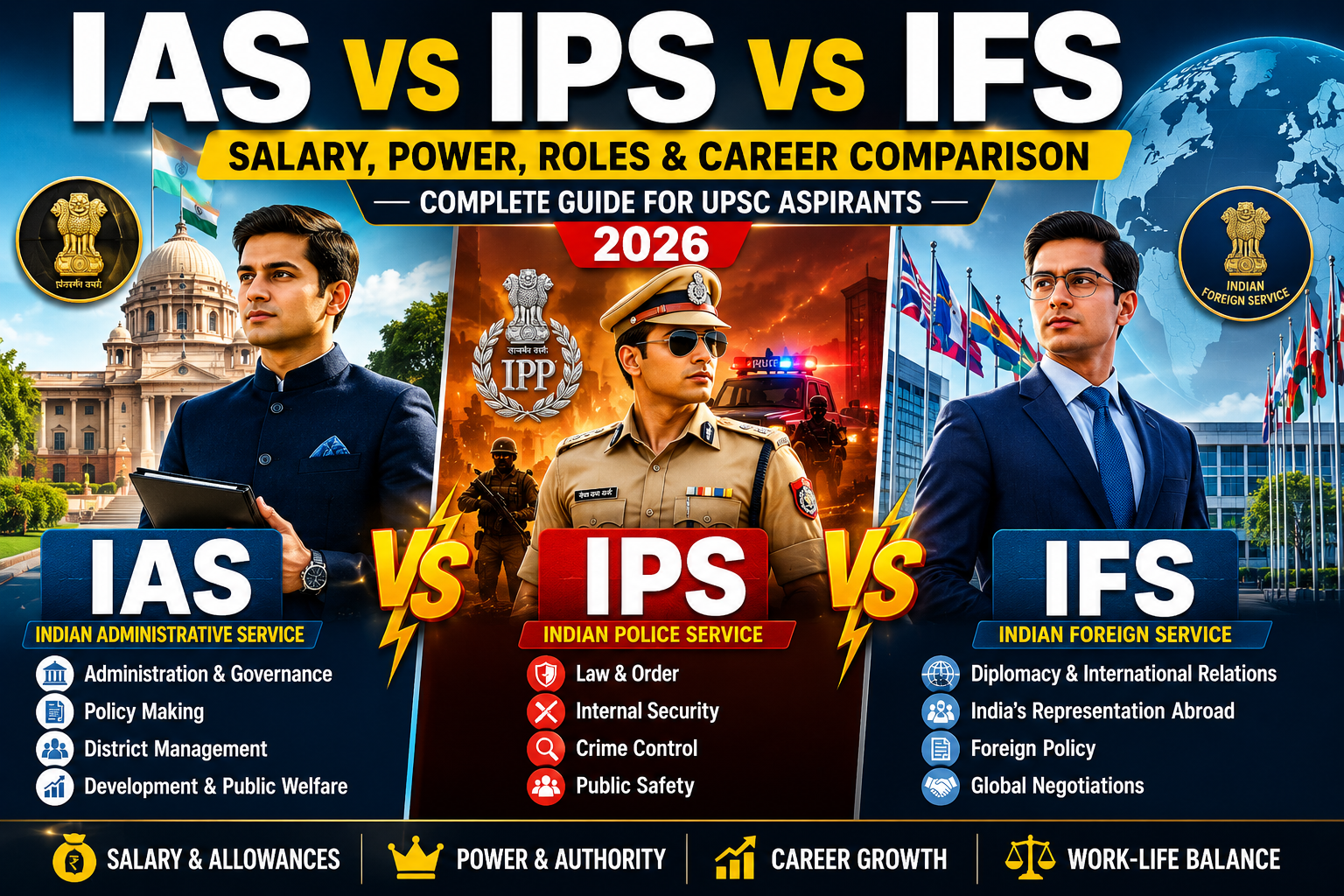
IAS vs IPS vs IFS – Salary, Power, Roles & Career Comparison (2026)
One of the most common questions among UPSC aspirants is:
“What is the difference between IAS, IPS, and IFS?”
Many students preparing for the Civil Services Examination want to understand which service offers more power, better career opportunities, higher salary, or a better work-life balance.
Although all three services are prestigious, they differ significantly in terms of responsibilities, career path, work environment, and lifestyle.
In this article, we will compare IAS vs IPS vs IFS in detail.
What Are IAS, IPS, and IFS?
All three services are among the top services recruited through the UPSC Civil Services Examination.
However, their work areas are different.
IAS – Indian Administrative Service
The Indian Administrative Service (IAS) is considered one of the most influential civil services in India.
IAS officers mainly handle:
- Administration
- Policy implementation
- Governance
- District management
- Government decision-making
IAS officers work closely with state and central governments.
They play a major role in implementing public policies and managing administration.
IPS – Indian Police Service
The Indian Police Service (IPS) focuses on law enforcement and internal security.
IPS officers are responsible for:
- Crime control
- Law and order
- Intelligence operations
- Public safety
- Police administration
They lead police departments at various levels.
IPS officers often work in high-pressure operational environments.
IFS – Indian Foreign Service
The Indian Foreign Service (IFS) handles India’s diplomatic and international affairs.
IFS officers work in:
- Embassies
- Consulates
- International organizations
- Ministry of External Affairs
Their responsibilities include:
- Diplomacy
- Foreign policy
- International negotiations
- Bilateral relations
IFS officers often represent India globally.
IAS vs IPS vs IFS: Roles and Responsibilities
Understanding job roles is essential before choosing preferences.
IAS Officer Responsibilities
An IAS officer may work as:
- District Magistrate
- Collector
- Secretary
- Commissioner
- Cabinet-level administrator
Key responsibilities include:
- Policy implementation
- Development programs
- Revenue administration
- Crisis management
- Public grievance handling
IAS officers frequently interact with political leadership and government departments.
IPS Officer Responsibilities
IPS officers handle policing and security operations.
Typical roles include:
- Superintendent of Police (SP)
- Deputy Inspector General (DIG)
- Inspector General (IG)
- Director General of Police (DGP)
Key duties:
- Crime prevention
- Investigation supervision
- Security management
- Anti-terror operations
- Public order maintenance
IPS careers can be dynamic and operationally intense.
IFS Officer Responsibilities
IFS officers operate in diplomatic and international settings.
Roles include:
- Diplomat
- Ambassador
- High Commissioner
- Foreign Policy Advisor
Major duties:
- Representing India abroad
- Negotiating treaties
- Managing diplomatic relations
- Trade discussions
- Cultural diplomacy
IFS careers involve global exposure.
IAS vs IPS vs IFS Salary Comparison
Many aspirants ask:
“Who earns more – IAS, IPS, or IFS?”
Under government pay structures, base salary levels are broadly similar.
However, allowances and benefits vary depending on posting.
IAS Salary
Approximate starting salary:
Level 10 Pay Structure
Basic salary begins around standard government entry-level officer scales.
Additional benefits may include:
- Government accommodation
- Official vehicle
- Security support
- Travel benefits
IPS Salary
IPS salary structure is similar to IAS.
Additional operational allowances may apply depending on posting and role.
Benefits can include:
- Government residence
- Official vehicle
- Security arrangements
- Field allowances
IFS Salary
IFS officers also follow government pay frameworks.
However, international postings often involve additional foreign allowances.
Benefits may include:
- International accommodation
- Diplomatic privileges
- Foreign posting benefits
- Travel facilities
Actual earnings vary by posting location.
IAS vs IPS vs IFS: Power and Authority
Power is a major factor influencing service preference.
However, “power” depends on the nature of responsibility.
IAS Power
IAS officers possess significant administrative authority.
They may supervise:
- District administration
- Government schemes
- Public policy execution
- Revenue management
Senior IAS officers often influence major governance decisions.
IPS Power
IPS officers exercise law enforcement authority.
Their power relates to:
- Policing
- Security operations
- Criminal investigations
- Intelligence coordination
IPS officers command police forces and operational units.
IFS Power
IFS authority is diplomatic rather than administrative or policing based.
Their influence lies in:
- International negotiations
- Foreign policy execution
- Diplomatic representation
IFS officers shape India’s global engagement.
IAS vs IPS vs IFS: Work Environment
Work culture differs significantly.
IAS Work Environment
IAS officers work primarily in:
- District administration
- Government departments
- Secretariats
- Policy institutions
The job often involves:
- Public interaction
- Administrative pressure
- Decision-making responsibility
IPS Work Environment
IPS work can be demanding.
Officers may handle:
- Crime investigations
- Emergency situations
- Security challenges
- Field operations
Operational intensity is usually high.
IFS Work Environment
IFS officers work in diplomatic settings.
Environment includes:
- Embassies
- International conferences
- Foreign ministries
- Multinational engagements
The work often involves diplomacy, negotiation, and representation.
IAS vs IPS vs IFS: Career Growth
Career progression differs across services.
IAS Career Path
Possible career progression includes:
- District-level administration
- State secretariat roles
- Central government leadership
- Senior administrative positions
Senior officers may hold highly influential policy roles.
IPS Career Growth
Career growth includes:
- District policing leadership
- State police command
- National security assignments
- Intelligence organizations
Senior officers can lead major law enforcement institutions.
IFS Career Progression
IFS career development includes:
- Diplomatic postings
- Embassy leadership
- International policy roles
- Ambassador-level assignments
IFS careers involve diverse global exposure.
IAS vs IPS vs IFS: Work-Life Balance
This factor matters for many aspirants.
IAS Work-Life Balance
Administrative pressure can be high.
Emergency responsibilities may affect personal schedules.
IPS Work-Life Balance
IPS jobs can involve unpredictable operational demands.
Work pressure may be intense in sensitive postings.
IFS Work-Life Balance
IFS officers may experience different challenges.
Frequent international transfers and diplomatic commitments can influence lifestyle and family adjustment.
Which Service Is Better – IAS, IPS, or IFS?
There is no universal answer.
The best choice depends on personality, interests, and career goals.
Choose IAS if you enjoy:
- Governance
- Administration
- Policy implementation
- Public management
Choose IPS if you prefer:
- Law enforcement
- Leadership under pressure
- Security operations
- Public order management
Choose IFS if you are interested in:
- Diplomacy
- International affairs
- Foreign policy
- Global engagement
Understanding your strengths is important before choosing service preferences.
Common Misconceptions About IAS, IPS, and IFS
Many students make assumptions based only on popularity.
Avoid these misconceptions.
“IAS is always better.”
Each service offers unique opportunities.
“IFS is only about foreign travel.”
Diplomatic work involves serious responsibilities.
“IPS is only about policing.”
IPS careers include leadership, intelligence, and national security roles.
Research carefully before making conclusions.
Final Thoughts
IAS, IPS, and IFS are among the most respected services in India.
Each offers:
- Prestige
- Responsibility
- Public service opportunities
- Career growth
However, their work styles, responsibilities, and career environments differ significantly.
Instead of asking:
“Which service is the most powerful?”
Ask:
“Which role aligns best with my interests, strengths, and long-term goals?”
That perspective leads to better career decisions.
Frequently Asked Questions (FAQ)
Which is better – IAS, IPS, or IFS?
There is no single best option. The right service depends on personal interests, career goals, and preferred work environment.
Who has more power – IAS or IPS?
IAS officers generally handle administration and policy implementation, while IPS officers manage policing and security functions.
Do IAS, IPS, and IFS officers receive the same salary?
Base pay structures are broadly similar, though allowances and benefits can vary by posting.
Which service offers international exposure?
IFS officers usually receive significant international exposure through diplomatic postings.