

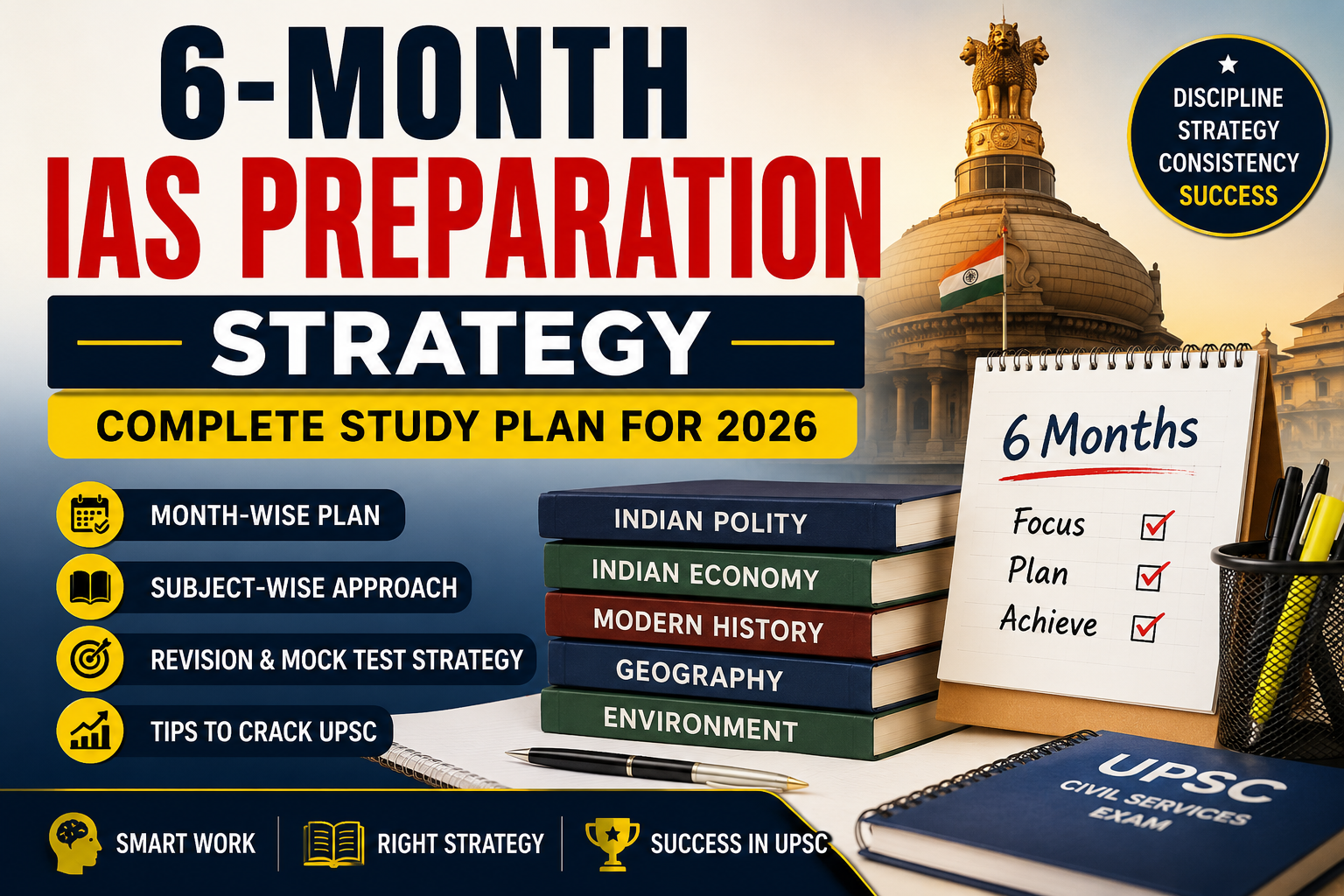
6-Month IAS Preparation Strategy – Complete UPSC Study Plan for 2026
One of the most common questions asked by UPSC aspirants is:
“Can I crack IAS in 6 months?”
The answer is:
Yes — but only with smart planning, focused preparation, and disciplined execution.
Six months may not sound like a long period for UPSC preparation, but with the right strategy, aspirants can build a strong preparation framework.
Whether you are a beginner, college student, dropper, or working professional, this guide will help you create a practical 6-month IAS preparation strategy for 2026.
Is 6 Months Enough for IAS Preparation?
Many students believe UPSC preparation always requires 2–3 years.
That is not always true.
Some aspirants clear UPSC with shorter preparation timelines because they:
- Study strategically
- Follow limited resources
- Revise consistently
- Practice regularly
- Stay disciplined
However, six-month preparation demands:
- High focus
- Strong planning
- Daily consistency
- Smart time management
The goal is not perfection.
The goal is maximum efficiency.
Understand the UPSC Syllabus Before Starting
Before creating a study plan, understand the UPSC syllabus clearly.
UPSC Civil Services Examination includes:
UPSC Prelims
- General Studies Paper 1
- CSAT Paper
UPSC Mains
- Essay
- General Studies Papers
- Optional Subject
- Language Papers
Interview
- Personality Test
- Awareness
- Communication Skills
Print the syllabus and keep it visible during preparation.
Your study should always remain syllabus-oriented.
Choose Limited Study Resources
One of the biggest reasons candidates struggle is resource overload.
Do not waste time collecting dozens of books.
Use trusted standard resources.
Recommended Book List
Polity
M. Laxmikanth
Modern History
Spectrum Modern History
Geography
NCERT + GC Leong
Economy
Ramesh Singh
Environment
Shankar IAS
Current Affairs
- Newspaper reading
- Monthly current affairs compilations
Limited resources improve revision quality.
Month-Wise 6-Month IAS Preparation Strategy
A month-wise roadmap can improve clarity and consistency.
Month 1 – Build Your Foundation
The first month should focus on fundamentals.
Tasks:
- Understand syllabus
- Read NCERT books
- Begin current affairs preparation
- Create study routine
- Start basic note-making
Subjects to prioritize:
- History
- Geography
- Polity basics
- Economy fundamentals
Goal:
Develop conceptual understanding.
Month 2 – Start Standard Books
After completing basics, move to advanced preparation.
Focus on:
- Standard UPSC books
- Topic-wise study
- Current affairs integration
- Short revision notes
Suggested subjects:
- Polity
- Economy
- Environment
- Modern History
Start solving simple MCQs.
Month 3 – Strengthen Concepts and Practice
This phase should combine learning and application.
Study goals:
- Continue syllabus coverage
- Practice MCQs
- Begin answer writing
- Strengthen weak subjects
Start connecting static subjects with current affairs.
Example:
Economy + Budget updates.
Environment + Climate developments.
Month 4 – Revision and Mock Test Phase
Revision becomes increasingly important.
Activities:
- Topic revision
- Full-length MCQs
- Timed answer writing
- Current affairs revision
Mock tests help identify:
- Weak areas
- Time management issues
- Conceptual gaps
Do not ignore performance analysis.
Month 5 – Intensive Practice Stage
This month should focus heavily on practice.
Important tasks:
Prelims Practice
- MCQs
- Previous year questions
- Timed mock tests
Mains Practice
- Answer writing
- Essay preparation
- Case study discussion
Keep revising standard books.
Month 6 – Final Revision and Exam Readiness
The last month should focus on consolidation.
Avoid studying entirely new material.
Instead, prioritize:
- Revision notes
- Mock test review
- Current affairs revision
- Weak topic strengthening
Maintain confidence and avoid panic.
Daily Study Plan for 6-Month UPSC Preparation
A structured daily schedule can improve productivity.
Morning Session
- Current affairs
- Newspaper reading
- Short revision
Afternoon Session
- Core subject study
- Concept building
Evening Session
- MCQ practice
- Answer writing
- Revision
Night Session
- Quick recap
- Study planning
Consistency matters more than marathon study sessions.
How Many Hours Should You Study Daily?
Study hours depend on your background and schedule.
Full-Time Aspirants
Many candidates target:
8–10 productive hours daily
Working Professionals
A realistic target may be:
3–5 hours on weekdays
Longer sessions on weekends
Remember:
Effective learning is more important than counting hours.
Current Affairs Strategy for 6-Month Preparation
Current affairs remain crucial.
Follow a simplified approach.
Daily
- Newspaper reading
- Short notes
Weekly
- Important topic revision
Monthly
- Current affairs compilation review
- MCQ integration
Avoid consuming excessive content from multiple sources.
Importance of Revision in a 6-Month Plan
Revision is the backbone of short-duration preparation.
Without revision, retention becomes difficult.
Recommended revision cycle:
Daily Revision
15–30 minutes.
Weekly Revision
Review completed topics.
Monthly Revision
Revise notes, tests, and weak areas.
Short notes, mind maps, and summary sheets can be very helpful.
Previous Year Questions (PYQs) Strategy
Previous Year Questions provide insight into UPSC thinking patterns.
Benefits include:
- Understanding trends
- Identifying important topics
- Improving question analysis
Use PYQs regularly.
Do not postpone them until the final stage.
Common Mistakes to Avoid During 6-Month Preparation
Many aspirants lose valuable time because of avoidable errors.
Using Too Many Books
Keep resources limited.
Ignoring Revision
Revision is essential.
Studying Without a Timetable
Structured planning improves consistency.
Skipping Mock Tests
Practice is critical.
Comparing Yourself with Others
Focus on your personal preparation journey.
Can Beginners Follow a 6-Month UPSC Strategy?
Yes, beginners can use a six-month approach.
However, they must:
- Build fundamentals quickly
- Avoid distractions
- Follow a focused schedule
- Prioritize revision
The preparation process should remain practical and disciplined.
Final Thoughts
Cracking IAS in six months is challenging but achievable.
Success depends on:
- Smart planning
- Limited resources
- Current affairs consistency
- Strong revision
- Practice-oriented preparation
You do not need the perfect plan.
You need a plan you can actually follow every day.
Stay focused, remain disciplined, and trust the preparation process.
Frequently Asked Questions (FAQ)
Can IAS be cracked in 6 months?
Yes, some aspirants prepare effectively within six months through disciplined study, revision, and strategic planning.
How many hours should I study for a 6-month UPSC plan?
Study hours vary, but productive and consistent preparation matters more than long schedules.
Is revision important in short-duration UPSC preparation?
Yes. Revision is one of the most important components of effective preparation.
Should I read multiple books in a 6-month strategy?
Using limited and standard resources generally improves focus and revision efficiency.