| Syllabus: GS PAPER 2 – Government Policies and Interventions for Development in various sectors; Welfare Schemes for Vulnerable Sections of the population; Issues relating to development and management of Social Sector/Services relating to Education, Health, Human Resources. GS PAPER 3 – Indian Economy; Inclusive Growth and issues arising from it; Employment; Women Entrepreneurship. |
| Womaniya: Building Inclusive Market Access for Women Entrepreneurs |
| Introduction: Womaniya – Opening the Door for Every Woman | Public procurement constitutes a major organised market in India. With the expansion of digital procurement through the Government e-Marketplace (GeM), the system has become more transparent, standardised and accessible to a wider supplier base.In order to encourage the participation of women-led micro and small enterprises (MSEs) and Self-Help Groups (SHGs), the Government introduced the Womaniya Initiative on GeM in 2019. The initiative aims to strengthen the inclusion of women entrepreneurs in public procurement by providing a designated digital interface, simplifying access requirements and creating structured pathways for women-entrepreneurs and SHGs to connect with Government buyers. |
| What is GeM? | The Government e-Marketplace (GeM) is an online platform that facilitates end-to-end procurement of goods and services by various Central/State Ministries, departments, organisations, public sector undertakings, Panchayats and Cooperatives.GeM was launched in 2016 under the vision of “Minimum Government, Maximum Governance,” as a paperless, cashless and contactless platform enabling Government buyers to directly procure goods and services from pan-India sellers online. |
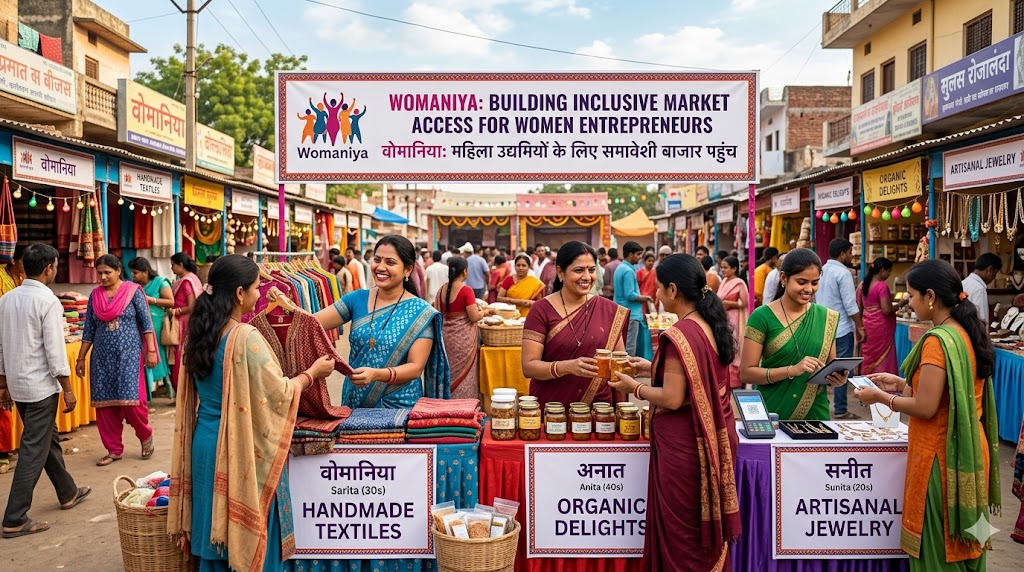
| Womaniya Initiative: A Dedicated Platform for Women Entrepreneurs | Womaniya is an inclusion-focused initiative on GeM that helps address constraints limiting women’s access to formal Government markets. Under the Ministry of Commerce & Industry, it provides a dedicated digital interface through which women MSEs and SHGs can register and list their products such as handloom, jute, coir and home décor items to be purchased directly by Central Ministries and PSUs anywhere in India.As of February 2026, 10.05 crore women have been mobilised into 90.09 lakh SHGs, expanding financial inclusion and collective economic action. SHGs are grassroots informal organisations of 10 to 20 members who pool their resources and engage in income-generating activities.The initiative supports women entrepreneurs by improving market visibility, enabling transparent buyer-seller interaction and reducing dependence on intermediaries. It aligns with the Government’s broader inclusion priorities of: expanding supplier diversity, strengthening women-led entrepreneurship, and integrating under-represented groups into organised procurement channels. |
| What is SWAYATT? | SWAYATT (Startups, Women & Youth Advantage Through e-Transactions) is a GeM initiative launched in February 2019 to promote inclusive participation in public procurement, focusing on startups, women entrepreneurs, youth, Micro & Small Enterprises (MSEs), Self-Help Groups (SHGs), and marginalised communities to access Government markets.Womaniya complements the broader inclusion agenda under the SWAYATT programme by removing entry barriers and enhancing ease of doing business for women-led enterprises on the GeM platform. |
| Product Categories Under Womaniya | Womaniya groups product-segments where women-led enterprises and SHGs already have strong production capacity. These categories are formally identified and made searchable for Government buyers through curated storefronts on GeM:Womaniya HandicraftsWomaniya Grocery and PantryWomaniya Office AccessoriesWomaniya Handloom TextilesWomaniya Personal Hygiene and CareBy listing these items within a unified category framework, GeM improves product discoverability and makes it easier for departments to source from women-led producers at scale. |
| Key Features of the Womaniya Initiative | Digital Onboarding of Women Entrepreneurs and SHGs: Women-led micro and small enterprises are onboarded through a digital process using Udyam verification and essential documentation. Capacity building is reinforced through immersive onboarding sessions via offline and online training workshops by GeM.Standardised Catalogue Listing: Products are listed using uniform catalogue templates with defined technical specifications and attributes, ensuring comparability across sellers and simplifying buyer evaluation.Transparent and Fully Digital Procurement Processes: All procurement activities including bidding, order placement, acceptance, invoicing and payments are executed digitally. This reduces intermediary dependence and enables direct engagement between women-led enterprises and Government buyers.Time-Bound Acceptance and Payment Mechanisms: Digitised workflows help ensure timely payments, a critical support for micro and small suppliers operating with limited working capital.Training, Outreach and Support Services: Under SWAYATT and Womaniya-focused programmes, GeM conducts capacity building activities such as onboarding workshops, vernacular training and buyer-seller meets across states. |
| From Participation to Prosperity: The Womaniya Impact | Implementation of “Womaniya on GeM” is a step towards a gender-inclusive procurement portal. Government buyers place orders and create demand for Womaniya-listed products, integrating women producers into procurement cycles.The Womaniya Initiative has expanded significantly since its launch. In FY 2025-26:Over 2.1 lakh women MSEs registered on GeM, with total order volume of 13.7 LakhMore than ₹28,000 crore contract value awarded to women MSEs with 27.60% growth over last year5.6% of GeM’s total orders awarded – significantly surpassing the mandated 3% procurement targetThe initiative has evolved from a specialised inclusion effort into one of the largest organised public procurement channels for women-led enterprises in the country, supported by the interconnected roles of digital infrastructure, field-level mobilisation, capacity building and institutional demand. |
| Significance of the Womaniya Initiative | Gender-Inclusive Public Procurement: Womaniya converts existing production strengths of women entrepreneurs – particularly in traditional crafts and textiles – into sustainable, formal enterprise participation at scale within India’s largest organised public market.Elimination of Intermediaries: The fully digital, transparent procurement architecture removes traditional gatekeepers, allowing women producers to deal directly with Government buyers and retain higher value from their enterprise.Grassroots Economic Empowerment: By bringing SHGs and rural women MSEs directly into the formal economy, Womaniya supports financial independence, rural income enhancement and economic democratisation at the grassroots level.Alignment with National Goals: The initiative reinforces the Government’s priorities of Atmanirbhar Bharat, inclusive growth, women-led development and the broader agenda of Digital India – harnessing technology for social and economic equity. |
| Challenges in Scaling Womaniya | Digital Literacy and Connectivity Gaps: Many women entrepreneurs, especially in rural areas, face limited access to smartphones, internet connectivity and digital literacy, hindering effective use of the GeM platform and limiting the reach of the Womaniya Initiative.Documentation and Compliance Barriers: Requirements such as Udyam registration, GST compliance and banking documentation can be challenging for informal SHGs and first-generation micro-entrepreneurs who lack prior exposure to formal business processes.Quality Standardisation and Catalogue Management: Maintaining consistent product quality, adhering to GeM’s catalogue specifications and managing logistics for timely delivery remain significant operational challenges for small and micro women enterprises.Regional Imbalance in Participation: Womaniya registrations and order volumes remain concentrated in certain states with stronger SHG networks and better digital infrastructure, while many eastern and northeastern states lag behind due to lower awareness and institutional support.Working Capital Constraints: Women MSEs and SHGs typically operate with limited capital. Delayed Government payments, despite digital workflows, can disrupt production cycles and cash flows, particularly for those fulfilling large Government orders for the first time. |
| Way Forward | Expand Digital Outreach and Vernacular Support: GeM should intensify vernacular-language training, mobile-first onboarding tools and community-level digital facilitation centres to bridge digital literacy gaps and bring more women MSEs from underserved regions into the platform.Streamline Documentation and Formalisation Pathways: The Government should simplify compliance procedures, integrate Udyam registration with SHG databases, and provide end-to-end assisted onboarding for first-time women sellers to reduce entry barriers into the formal procurement ecosystem.Strengthen Financial Support Mechanisms: Access to working capital finance, invoice discounting facilities and credit guarantees tailored for women MSEs must be improved. Linking Womaniya sellers with schemes like the Credit Guarantee Fund Trust for Micro and Small Enterprises (CGTMSE) can provide essential financial cushioning.Incentivise Government Buyers to Exceed Procurement Targets: Mandatory procurement targets for Womaniya products should be enhanced beyond the current 3%, and performance metrics for ministries and departments should explicitly reward sourcing from women-led enterprises.Leverage Technology for Quality Assurance and Logistics: Investment in quality testing labs, shared logistics hubs and packaging support centres at the district level can help women MSEs meet procurement standards, scale fulfillment capacity and compete effectively for larger Government orders. |
| Conclusion: | By giving women-led enterprises and SHGs a direct path into one of India’s largest public markets, the Womaniya Initiative on GeM converts existing production strengths into formal, sustainable enterprise participation. As more women gain visibility, build capacity and connect with Government buyers, Womaniya becomes not just a procurement initiative but a pathway to greater economic independence and wider representation – ensuring that public procurement reflects the capabilities and aspirations of the better half of society. |