| Syllabus: GS PAPER 3 – Technology Missions; Infrastructure: Energy; Indian Economy and issues relating to Planning, Mobilization of Resources, Growth, Development and Employment; Inclusive Growth and issues arising from it; Conservation, Environmental Pollution and Degradation; Defence. |
| India’s Rare Earth Strategy and Its Global Implications |
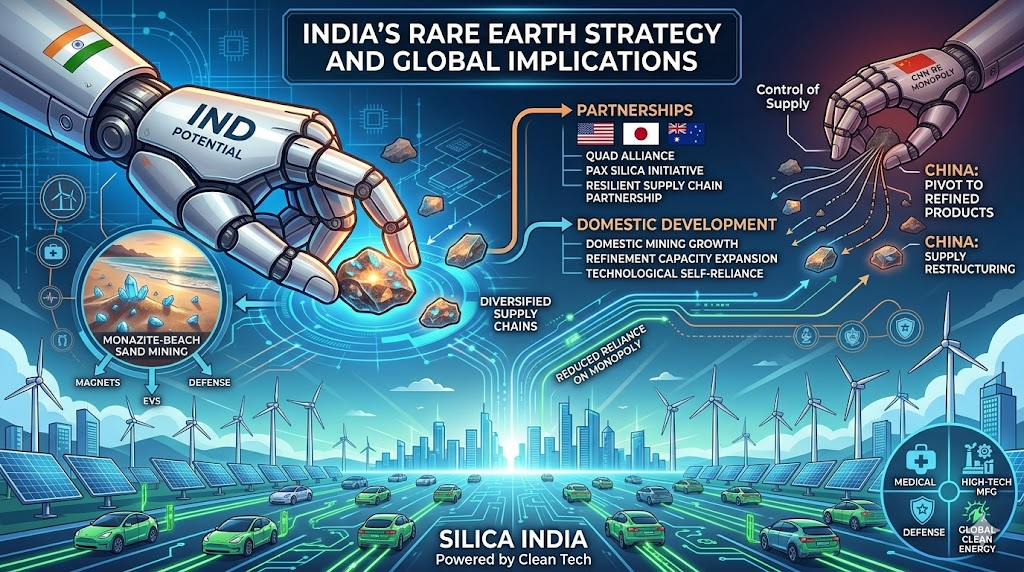
| Current Status of India’s Rare Earth Sector | India possesses one of the world’s most substantial rare earth mineral bases, yet its downstream manufacturing capability remains at a developing stage, creating a strategic gap that recent policy has moved to address. As of November 2025, the government approved a landmark ₹7,280 crore Rare Earth Permanent Magnet (REPM) Manufacturing Scheme, targeting the creation of 6,000 MTPA of integrated sintered REPM manufacturing capacity. India’s resource base is substantial: 13.15 million tonnes of monazite deposits with an estimated 7.23 million tonnes of rare earth oxides (REO)482.6 million tonnes of rare earth ore resources identified by the Geological Survey of India (GSI) across 34 exploration projectsDeposits spread across Odisha, Kerala, Andhra Pradesh, Tamil Nadu, West Bengal, Gujarat, Maharashtra, and Jharkhand1.29 million tonnes of in-situ REO identified in hard-rock areas of Gujarat and Rajasthan Despite this, India imported 60–80% by value and 85–90% by quantity of permanent magnets—primarily from China—between 2022–25. The Union Budget 2026–27 further announced Dedicated Rare Earth Corridors in Odisha, Kerala, Andhra Pradesh, and Tamil Nadu to foster integrated mining, processing, research, and manufacturing. |
| Benefits of India’s Rare Earth Strategy | Strategic Self-Reliance (Atmanirbhar Bharat): Reduces import dependence from China which supplied 85–90% of permanent magnets by quantity between 2022–25, thereby insulating critical supply chains from geopolitical disruptions.Establishes India as an end-to-end producer—from rare earth oxides to finished magnets—enhancing supply chain sovereignty. Clean Energy Transition: REPMs are essential for EV motors and wind turbine generators, both central to India’s Net Zero 2070 ambition and the 500 GW non-fossil capacity target by 2030Domestic REPM production will reduce the cost and import risk for the clean energy manufacturing ecosystem. National Security and Defence: Rare earth magnets are critical for aerospace systems, precision sensors, and defence equipment. Domestic capacity ensures secure, uninterrupted access for strategic applications. Macroeconomic and Employment Gains: The ₹7,280 crore scheme is expected to attract large-scale investment across five beneficiaries selected via global competitive bidding, generating industrial employment in mineral-rich states.₹6,450 crore in sales-linked incentives over five years alongside ₹750 crore in capital subsidies will catalyse private sector participation. Regional Economic Development: The Dedicated Rare Earth Corridors will generate stronger local economies in Odisha, Kerala, Andhra Pradesh, and Tamil Nadu, enhancing R&D capacity and integrating these states into global advanced-materials value chains. |
| Steps Taken by the Government | REPM Manufacturing Scheme (November 2025) Financial outlay: ₹7,280 croreCapacity: 6,000 MTPA integrated REPM manufacturing (sintered magnets)Up to five beneficiaries through global competitive bidding₹6,450 crore sales-linked incentives over five years₹750 crore capital subsidy for advanced facilitiesTwo-year gestation for setup, followed by five years of incentive disbursement Union Budget 2026–27: Dedicated Rare Earth Corridors Corridors in Odisha, Kerala, Andhra Pradesh, and Tamil Nadu for integrated mining, processing, R&D, and manufacturingLeverages existing IREL (India) Limited infrastructure—Rare Earth Extraction Plant (Odisha) and Rare Earth Refining Unit at Aluva (Kerala)  Legislative and Institutional Reforms: MMDR Act (amended 2023): Introduced a dedicated critical minerals list; opened exploration and mining to private participationNational Critical Minerals Mission (NCMM, January 2025): Provides overarching strategy for sustainable rare earth and critical mineral supply chains International Partnerships: Bilateral mineral agreements with Australia, Argentina, Zambia, Mozambique, Peru, Zimbabwe, Malawi, and Côte d’IvoireParticipation in Minerals Security Partnership (MSP) and Indo-Pacific Economic Framework (IPEF)KABIL (JV of NALCO, HCL, MECL): Signed agreement with CAMYEN, Argentina for five lithium brine blocks Legislative and Institutional Reforms: MMDR Act (amended 2023): Introduced a dedicated critical minerals list; opened exploration and mining to private participationNational Critical Minerals Mission (NCMM, January 2025): Provides overarching strategy for sustainable rare earth and critical mineral supply chains International Partnerships: Bilateral mineral agreements with Australia, Argentina, Zambia, Mozambique, Peru, Zimbabwe, Malawi, and Côte d’IvoireParticipation in Minerals Security Partnership (MSP) and Indo-Pacific Economic Framework (IPEF)KABIL (JV of NALCO, HCL, MECL): Signed agreement with CAMYEN, Argentina for five lithium brine blocks |
| Impacts of India’s Rare Earth Strategy | India’s decisive push into rare earth permanent magnet manufacturing carries far-reaching structural, economic, and geopolitical implications for both its domestic economy and global advanced-materials markets. Industrial Value Chain Development: The scheme will establish an end-to-end REPM ecosystem—from rare earth oxides to finished magnets—enabling India to participate across the entire value chain rather than as a raw material exporter.Reduction in Import Dependence: With domestic REPM capacity of 6,000 MTPA, India targets a dramatic reduction in the 85–90% import dependency by quantity that characterised 2022–25, cushioning the economy from supply chain shocks.Global Supply Chain Diversification: India’s entry as a credible REPM producer offers global clean energy manufacturers—especially in EVs and wind energy—an alternative to China, reducing systemic concentration risk in global rare earth supply chains.Geopolitical Positioning: Domestic rare earth capability enhances India’s leverage in international climate negotiations and strengthens its standing as a Quad and G20 partner on critical minerals diplomacy.Clean Energy and Defence Resilience: Secure domestic REPM supply chains will directly support India’s EV transition, wind energy scale-up, and defence indigenisation under Atmanirbhar Bharat. |
| Significance of India’s Rare Earth Strategy | India’s rare earth strategy is of civilisational significance—it positions the country not merely as a resource-rich nation, but as a global advanced-materials power capable of shaping the clean energy and defence economies of the 21st century.Model for Developing Economies: India’s approach—combining domestic resource mobilisation, targeted financial incentives, spatial corridor planning, and proactive diplomacy—offers a replicable policy framework for other resource-rich developing nations.South–South Cooperation: Through the Minerals Security Partnership (MSP) and bilateral agreements, India is fostering South-South cooperation on critical minerals, strengthening Global South diplomacy alongside its ISA solar leadership.Alignment with National Vision:Atmanirbhar Bharat: Reduces strategic import dependence in a critical sectorNet Zero 2070: Ensures domestic supply of materials essential for clean energyViksit Bharat @2047: Positions advanced materials manufacturing as a pillar of developed-nation statusAcademic and Research Significance: India’s REPM strategy offers rich case studies in industrial policy design, incentive structuring, and critical mineral governance—of direct relevance to researchers in economics, international relations, and energy policy. |
| Challenges in India’s Rare Earth Strategy | Nascent Downstream Manufacturing Base: Despite vast reserves, India lacks the processing and refining technology to convert raw monazite into high-purity separated rare earth oxides at scale, requiring significant capability building from scratch.Thorium-Related Regulatory Complexity: Indian monazite deposits are thorium-bearing, and thorium is a prescribed substance under the Atomic Energy Act. Processing these deposits involves complex regulatory clearances, slowing the pace of commercialisation.China’s Dominance and Technology Gap: China controls ~60% of global rare earth mining and over 85% of global REPM manufacturing capacity, with decades of accumulated metallurgical expertise. Bridging this technology gap within a 2-year gestation window is a formidable challenge.Critical Mineral Import Dependence: While India has REE reserves, it remains dependent on imports for heavy rare earths (dysprosium, terbium) essential for high-performance magnets, with limited domestic occurrences identified so far.Infrastructure and Transmission Bottlenecks: Mining and processing corridors in coastal states require substantial evacuation infrastructure, port connectivity, and inter-state logistics—delays in which could constrain timelines.Environmental and Community Concerns: Rare earth mining in coastal ecosystems can affect biodiversity, groundwater, and local livelihoods. Balancing industrial scale-up with environmental sustainability and community consent remains a critical governance challenge.Skilled Workforce Shortage: The entire REPM value chain—from hydrometallurgical processing to sintered magnet manufacturing—requires highly specialised technical talent that India’s current workforce is not yet fully equipped to supply. |
| Way Forward | Accelerate Rare Earth Processing Technology: India must invest in solvent extraction, ion-exchange, and advanced hydrometallurgical processes to convert monazite into separated rare earth oxides. International example: Japan’s partnership with Australia (Lynas Corp) demonstrates how technology-sharing agreements can bridge processing gaps swiftly.Resolve Thorium Governance Framework: A dedicated policy framework under the Atomic Energy Act must streamline thorium by-product handling, enabling commercial extraction of REEs from monazite without prolonged regulatory delays.Build a Heavy Rare Earth Supply Chain: India must proactively secure dysprosium and terbium supplies—essential for high-performance magnets—through overseas mineral agreements (KABIL) and targeted GSI exploration. International example: The EU’s Critical Raw Materials Act mandates strategic reserves and supplier diversification, a model India could adapt.Develop Integrated R&D and Skill Ecosystem: Dedicated rare earth research centres within the corridors, linked to IITs and national labs like BARC and CSIR, can accelerate indigenous technology development and workforce training.Strengthen Environmental Governance: Adopt international best practices for rare earth mining—such as dry tailings storage and thorium immobilisation—to ensure that industrial scale-up does not compromise coastal ecology or community rights. International example: Australia’s Lynas facility in Malaysia has implemented strict environmental standards that can be adapted for Indian contexts.Leverage IPEF and MSP for Technology Transfer: India should actively use its membership in the Indo-Pacific Economic Framework (IPEF) and Minerals Security Partnership (MSP) to attract foreign direct investment in REPM technology, joint ventures, and co-development of rare earth processing capacity.Incentivise Circular Economy and Recycling: With global REPM demand set to double by 2030, magnet recycling and urban mining offer a supplementary supply pathway. International example: The EU and Japan have both invested in rare earth recycling from end-of-life electronics and EV motors, reducing primary mining pressure. |
| Conclusion | India’s rare earth strategy marks a structural shift in its industrial and strategic architecture—not merely a policy initiative, but a sovereign reclamation of critical materials leadership. By aligning the ₹7,280 crore REPM Manufacturing Scheme, Dedicated Rare Earth Corridors, and proactive global mineral partnerships with its Atmanirbhar Bharat, Net Zero 2070, and Viksit Bharat @2047 visions, India has articulated a comprehensive framework for self-reliance in advanced materials. As the International Energy Agency has observed, “the future of clean energy is a story of minerals.” India, with the fifth-largest rare earth reserves globally and a decisive policy commitment, is now writing its own chapter—one that holds the potential to reshape global supply chains, strengthen its diplomatic standing, and ensure that the materials of the 21st century are produced on Indian soil. |